Finding out that a vulnerability exists is rarely the hard part. The hard part is working out whether it touches your environment, and that usually means hours of searching advisories, cross-checking inventories, and stitching findings together from several tools. OX Security is betting that software can do that matching for you. Its new OX Radar and Response Center aims to answer the question teams actually ask: are we affected?
Matching threats to your environment
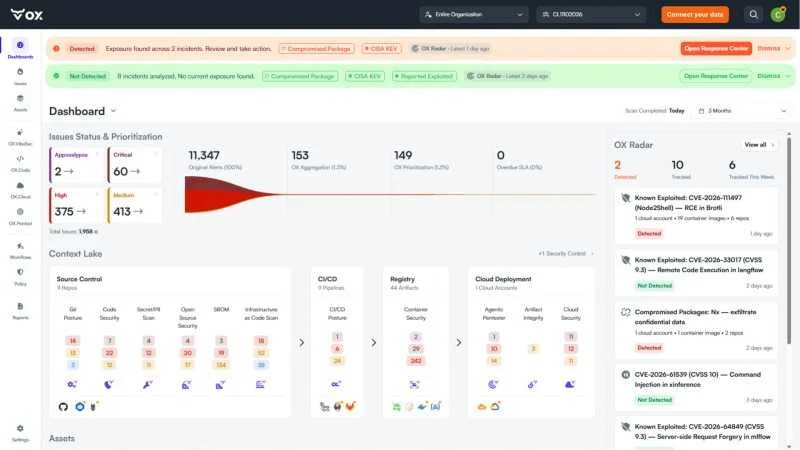
OX Radar watches emerging vulnerabilities, compromised software dependencies, and actively exploited threats. It scans CVE databases, known-exploited vulnerability catalogs, security advisories, and vendor research roughly every 10 minutes. The customer-facing side concentrates on three categories: compromised or malicious dependencies, exploited vulnerabilities, and critical-severity CVEs.
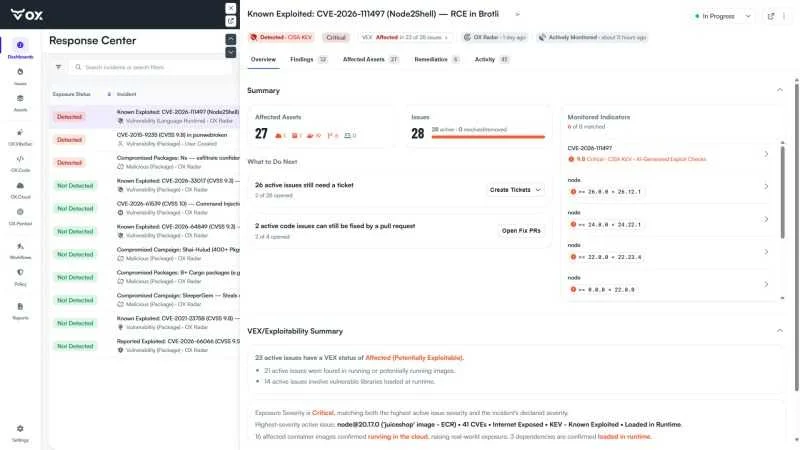
The Response Center does the matching. It checks whether vulnerable components are present in a customer's environment and assesses how exploitable they are. The inputs are a mix of sources: the U.S. Cybersecurity and Infrastructure Security Agency (CISA) and European Union Agency for Cybersecurity (ENISA) Known Exploited Vulnerabilities catalogs, EPSS exploit predictions, and VEX exploitability status. On top of those, OX layers its own AI-generated exploit checks and runtime visibility to decide whether a vulnerable library is actually reachable.
That last step is where the tool has to earn its keep. A CVE in a dependency that never executes in production is a different problem from one sitting on a live request path, and most alerting tools don't separate the two well.
What teams can do with it
Through the Response Center, security teams can work a threat from first alert to closed ticket:
- Track threats: Follow high-priority incidents as new intelligence and findings come in.
- Assess exposure: Identify affected assets and review the supporting evidence.
- Prioritize risk: Weigh severity, exploitation, code usage, and reachability.
- Manage remediation: Pull safe versions and guidance, then create or track tickets and fix pull requests.
- Document response: Keep records of findings and remediation activity.
For each supported incident, the Response Center shows whether a vulnerability was detected in the customer's environment, what evidence points to potential exploitability, and any VEX information that bears on whether action is needed. Teams can also start an investigation from a CVE identifier, a GitHub Security Advisory identifier, or an advisory URL, which matters when an alert arrives in a format that doesn't match the internal inventory.
A public feed for the wider supply chain
Alongside the customer tooling, OX is opening a public OX Radar threat feed. It draws on the company's own research and scanning to analyze newly published npm and PyPI packages, AI skills, and Model Context Protocol (MCP) servers. That last category is the newest and least-watched part of most dependency sprawl, and it's worth paying attention to.
The feed and the Response Center are meant to connect. OX says it will bring more of its public research findings into the Response Center over time, widening the set of threats it can check against customer environments.
Availability
OX Radar and Response Center are available now to OX Security customers as part of its AI-Native Application Protection Platform (AINAPP). The broader OX Radar research feed is publicly accessible through the OX Security website.
Neatsun Ziv, CEO and co-founder of OX Security, framed the problem this way: "The question isn't just whether a new threat is dangerous. It's whether it's dangerous to you." That's the right framing. Alert volume keeps climbing as AI speeds up development and widens the supply chain, so the scarce resource is context. The real test is whether per-environment matching holds up when a fast-moving incident hits, and whether the public feed's coverage grows as quickly as OX says it will.


