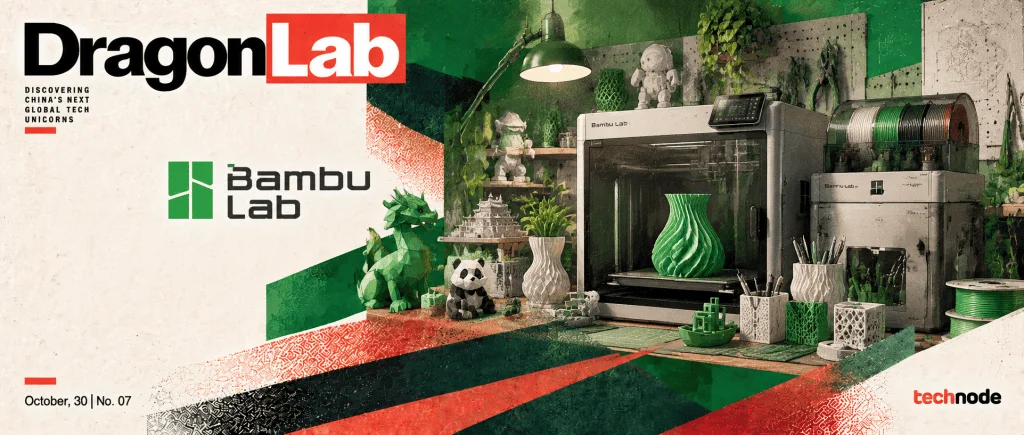
Bambu Lab’s rise points to a practical shift in desktop 3D printing: the machine matters, but so does reducing the work between choosing a design and getting a usable object. By late 2025, the Shenzhen company led global shipments of printers priced below US$2,500, with a 37% share, according to CONTEXT data. Its next move, a laser cutter, suggests the company sees room to build beyond printing.
Making the printer easier to live with
When Bambu Lab launched its X1 series in 2022, it went straight to a global audience through Kickstarter. The campaign attracted 5,575 backers and raised RMB 47.28 million. The company, founded in Shenzhen in 2020 by a team with former DJI employees, had already received angel backing from Mingshi Investment in 2021.
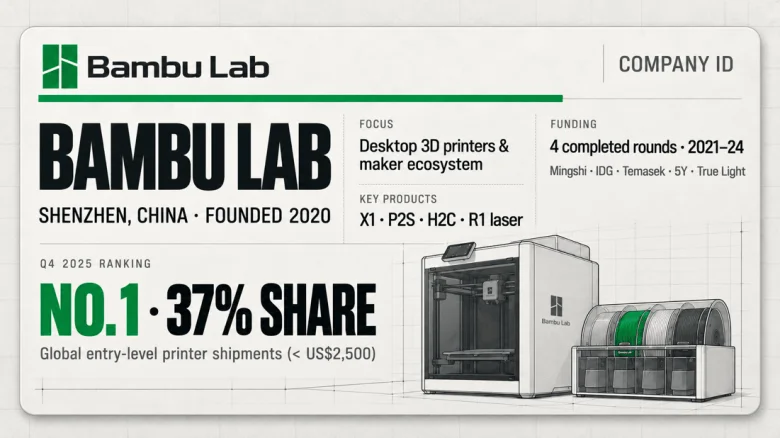
Funding followed: IDG Capital led a RMB 30 million Series A in 2022; a 2023 Series B included Mingshi, 5Y Capital, Temasek, and True Light Capital; and IDG provided RMB 150 million in Series C funding in April 2024. Bambu Lab operates research and development centers in Shenzhen and Shanghai, plus an Austin, Texas, office.
The X1 addressed a familiar pain point. Desktop printers could offer creative freedom, but using them often meant handling calibration, tuning, maintenance, and failed jobs. Automated calibration, cameras, lidar-assisted monitoring, and the Automatic Material System for multicolor printing made the machine feel more appliance-like. The engineering mattered; so did the confidence it gave users when starting a print.
The workflow is part of the product
Bambu Lab’s offering now spans printers, software, branded filament, accessories, the Bambu Handy app, and MakerWorld, a platform for sharing models. The combination helps users move from finding a design to producing it, while giving the company a relationship with customers beyond the initial hardware sale.
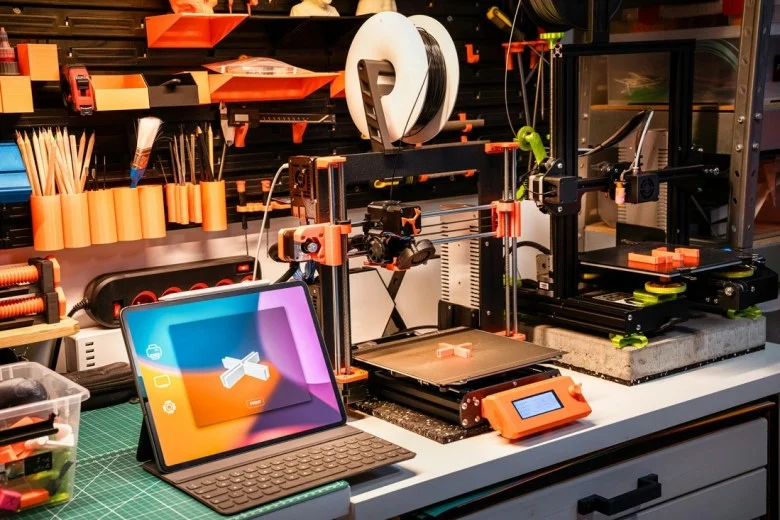
For makers, educators, small studios, online sellers, and print farms, a printer’s value depends on the surrounding workflow: reliable settings, useful models, compatible materials, and a community. MakerWorld had about 10 million monthly active users by the end of 2025, with an 83% one-year retention rate. Those figures make the platform a meaningful part of Bambu Lab’s business, not just a companion site.
Demand is growing at home as well as overseas. By June 2026, Bambu Lab said cumulative domestic sales of consumer 3D printers had passed one million units. The company also reported 2025 revenue above RMB 10 billion.
A broader product range
The company is extending its original X1 proposition across different price and capability tiers. The P2S targets serious hobbyists and small businesses, adding AI error detection, improved airflow, and a quick-swap nozzle system. At the higher end, the H2C’s Vortek system supports up to six interchangeable hotends and as many as 24 filaments, a design intended to reduce material waste during color changes.
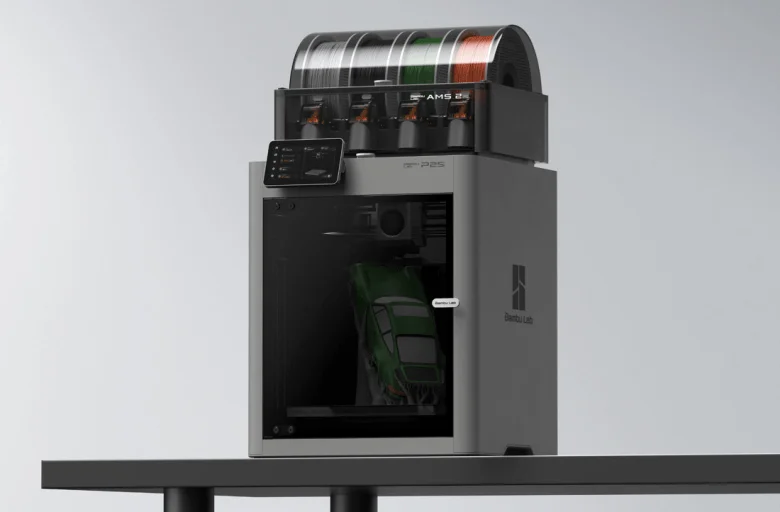
The H2D Pro moves toward enterprise applications, with support for high-temperature materials, a 350°C nozzle, and an actively heated chamber. Together, the models show Bambu Lab reaching for more demanding work while preserving its appeal to buyers who want capable equipment without a steep setup burden.
Its rapid growth has also brought a patent dispute. In September 2026, a Texas jury awarded Stratasys US$27.6 million after finding Bambu Lab liable for infringing four patents. Bambu Lab plans to seek review and appeal. A European court had previously declined to issue an injunction in a related case, and the dispute remains unresolved.
From additive manufacturing to desktop fabrication
In September 2026, Bambu Lab introduced the R1, a 55W CO₂ laser cutter and engraver and its first dedicated product line outside 3D printing. It can work with materials including wood, acrylic, leather, paper, and fabric.
The expansion fits the company’s existing audience: someone printing a plastic enclosure might also want to cut an acrylic panel or engrave a logo. Bambu Lab is testing whether its combination of accessible hardware and a connected software and user ecosystem can carry into other desktop manufacturing tools. Its next challenge is making that wider range work as simply as the printer that brought customers in.
DragonLab cuts through the noise to find the Chinese startups, founders, and technologies that could shape what comes next.
Have a startup we should know about? Reach us at [email protected].