The most interesting part of the possible sixth dwarf planet is how long it may have been hiding in plain sight. Researchers have traced the object, called ED138, through observations dating back to 2016. It’s still only a candidate: the International Astronomical Union’s Minor Planet Center will need to assess whether it qualifies.
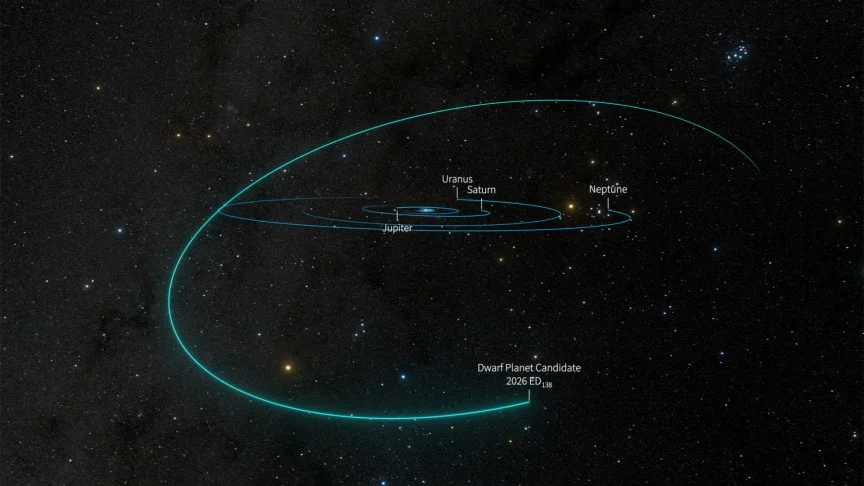
Only five dwarf planets are currently recognized in our solar system: Pluto, Ceres, Eris, Haumea and Makemake. Discoveries of new objects aren’t unusual in a universe this vast—sometimes they turn up by accident—but finding a potential addition to that short list is another matter. Researchers working with the Vera C. Rubin Observatory think ED138 may be number six.
The trail began earlier in October, when Rubin Operations team member Matthew Holman spotted an unusually large object in data flagged by a moving-object search program he built with colleague Kevin Napier. Holman’s first response was “excited disbelief,” he said in a statement, followed by a check that the detection wasn’t a mistake in his code or analysis.
That skepticism paid off. Holman reran the search against archived Rubin data and found ED138 another 20 times, with observations reaching back to March 2026. He then checked records from the US National Optical-Infrared Astronomy Research Laboratory’s Dark Energy Camera and the Asteroid Institute’s Asteroid Discovery Analysis and Mapping Precovery service. Those searches turned up sightings as far back as 2016.
Here’s the thing: a long observation record makes ED138 a stronger candidate, but it doesn’t settle the classification. The team has submitted the object to the International Astronomical Union’s Minor Planet Center for further study. Whether it joins Pluto, Ceres, Eris, Haumea and Makemake remains an open question.
Why ED138 could qualify
ED138’s importance comes down to a distinction that sounds technical but sets the boundary between planets and dwarf planets: whether a body has cleared its orbit. The object sits beyond Neptune, making it a trans-Neptunian object, and early estimates put its width between 600 and 1,500 kilometers. That may be enough for its own gravity to pull it into a rounded shape, though the size estimate is still preliminary.
To count as a dwarf planet, ED138 must orbit the sun, be massive enough to become roughly spherical under its own gravity, and not be a moon. It must also share its orbital neighborhood with other debris. A full-sized planet has cleared that neighborhood by absorbing nearby material, scattering it through gravity or placing it into stable orbits; Earth’s moon is one example of the last outcome.
That distinction explains why an object can be large and round yet still not qualify as a planet. It also makes any new dwarf planet a noteworthy find. Rubin Observatory has already submitted 11,000 new asteroid discoveries since beginning its sky survey in June 2025, so ED138 is part of a much larger stream of discoveries. But only five bodies currently share the dwarf planet designation: Eris, Ceres, Haumea, Makemake and Pluto, which was reclassified 20 years ago.
Here’s the less obvious part: ED138 may have been seen before. Its position against the Milky Way puts it in a dense field of millions of stars, where a faint object could disappear into the background. Finding it now says as much about the difficulty of searching as it does about how many undiscovered bodies remain.
Researchers at Rubin say the observatory may turn up more candidates. “Rubin is giving us an unprecedented capacity to explore the sky through a combination of speed, depth, and precision,” Mario Jurić, a member of the Rubin Solar System Operations team, said in a statement. “And the discovery is just the beginning: once we identify a new object, we can search back months, and sometimes even decades, finding it in images where nobody knew to look.” If ED138 holds up as a dwarf planet, the bigger story may be that Rubin can revisit old images and spot objects that earlier searches missed.