Anthropic’s compute bill tells two stories at once: running Claude for paying customers has become far more affordable relative to revenue, while the company is committing to an enormous amount of future capacity. The filing puts first-half 2026 compute and infrastructure spending at $8.95 billion, but estimates that no more than 27% went to serving customers. The rest supported training, research, free access and internal use.
That gap matters. Anthropic generated $16.29 billion in revenue in the first half, and serving customers cost $2.38 billion. Yet the company has signed compute deals whose named commitments and estimates add up to roughly $782 billion to $807 billion across multiple years. Those contracts could support growth and model development, but the hardware will arrive on schedules that don’t necessarily match revenue.
Claude’s serving economics have improved sharply
Anthropic’s S-1 filing separates costs into three broad categories. Cost of revenue covers inference for paying customers. Research and development includes most compute for model training and research, along with internal use. Sales and marketing includes expenses such as fees paid to channel partners and cloud resellers.
Comparing the first halves of 2025 and 2026, cost of revenue rose about 2.3 times. Revenue, however, grew from $1.16 billion to $16.29 billion, or about 14 times. On the filing’s figures, Anthropic kept roughly 85 cents of each revenue dollar after serving costs in the first half of 2026, compared with about 12 cents a year earlier.
Partner fees and marketing change the picture, but not the direction: after those expenses as well as serving costs, the estimated share retained rose from about 2 cents per dollar to 66 cents. Sales and marketing spending climbed about 16 times year over year. Research and development grew about five times, making it the main source of Anthropic’s operating loss.
The company says newer models have also reduced the cost of typical workloads. In September, Anthropic said Opus 5.5 cut cost per task by about 40% compared with Opus 5, while Fable 5.1 reduced typical workload costs by about 25% versus Fable 5. Anthropic attributed both changes to lower prices and improved efficiency, while saying it preserved margins.
First half of 2025 | First half of 2026 | |
|---|---|---|
Revenue | $1.16 billion | $16.29 billion |
Compute and infrastructure, all workloads | $2.33 billion | $8.95 billion |
Serving customers (cost of revenue) | $1.02 billion | $2.38 billion |
Free access to Claude, at most (est.) | $119 million | $640 million |
Training, research and internal use, at least (est.) | $1.20 billion | $5.93 billion |
Serving share of compute, at most | 44% | 27% |
Revenue left after serving costs | 12% | 85% |
Revenue left after serving costs, partner fees and marketing | 2% | 66% |
The remaining compute mostly supports development
Anthropic describes compute as “a single, shared resource across all workloads” and doesn’t disclose how it allocates that resource among serving, training and research. The filing’s estimates put at least $5.93 billion of first-half 2026 compute and infrastructure spending toward training, research and internal use. Free Claude access could account for as much as $640 million.
There’s an important limit to the efficiency story: Anthropic says it has “consistently operated in a compute-constrained environment where customer demand exceeds available compute.” In other words, low serving costs relative to revenue may reflect both better efficiency and limited supply. If more capacity arrives, it could help the company serve more demand, but the filing doesn’t establish how much that additional usage will cost or earn.
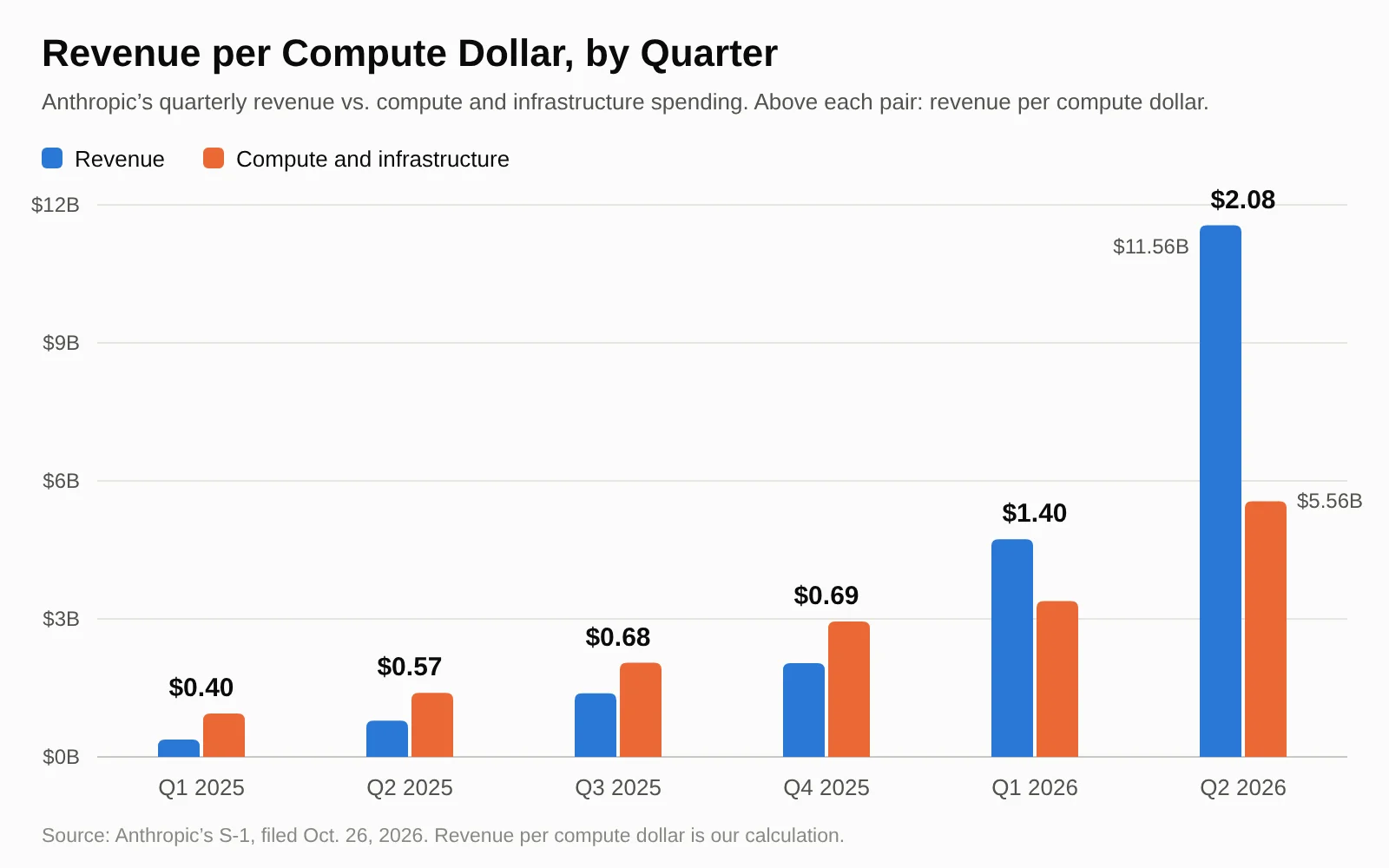
Anthropic’s reported revenue per compute dollar rose from $0.40 in Q1 2025 to $2.08 in Q2 2026. The company links that pattern to purchasing capacity 12 to 18 months ahead. Its committed compute base “did not fluctuate with in-period demand,” so revenue could rise faster than the expense recognized for capacity already available. Short-term compute bought to cover demand spikes typically costs more per unit.
Long-term supply contracts raise the stakes
The filing describes a mix of AWS Trainium, Google TPUs, Nvidia GPUs and AMD GPUs, but gives no breakdown by chip type or power capacity. Its named deals span equipment leases and compute purchases, with different delivery schedules and cancellation terms.
For TPUs, Anthropic has five-year equipment leases with Broadcom carrying about $161.2 billion in rent, excluding interest. Some capacity came online in 2026, with more scheduled from 2027. A separate deal with Google covers at least $114.5 billion between April 2026 and July 2033. The filing also points to additional TPU capacity from Google and other providers in 2028 through 2031, estimated at $125 billion to $150 billion.
Amazon’s agreement covers at least $110 billion between May 2026 and April 2036, though the filing doesn’t state how much of the AWS spend is specifically for Trainium. Nvidia capacity includes deals for up to $120.5 billion with SpaceXAI, at least $44.9 billion with Microsoft, up to about $44.6 billion with Nscale, and about $41.3 billion with Lambda. An AMD hardware supply agreement could exceed $20 billion if Anthropic takes the full initial capacity.
Anthropic’s minimum purchase commitments, excluding equipment leases, rose from about $55 billion at the end of 2025 to about $265.6 billion by the end of Q2 2026. Since then, the company has signed roughly $245 billion in new minimums and leases. The contracts don’t all create the same level of exposure: some are minimum payments regardless of use, while others depend on delivery, availability or deployment conditions. The SpaceXAI arrangement is among the more flexible Nvidia deals, allowing cancellation on 90 days’ notice after initial periods ending in January and March 2027.
Partner | Hardware | Amount | Term | Can Anthropic walk away? |
|---|---|---|---|---|
Broadcom | Google TPUs (equipment leases) | About $161.2 billion in rent | Five-year leases; some capacity online in 2026, more from 2027 | No, except on default |
Google TPUs | At least $114.5 billion | April 2026–July 2033 | No, except on Google’s uncured material breach; minimum owed regardless of use | |
TPU providers, including Google | Google TPUs | $125–150 billion (estimated) | Delivered 2028–2031 | Not stated; payments depend on capacity made available and deployment conditions |
Amazon | AWS (Trainium among its chips) | At least $110 billion | May 2026–April 2036 | No, except on Amazon’s uncured material breach; minimum owed regardless of use |
SpaceXAI | Nvidia GPUs | Up to $120.5 billion; about $3.1 billion a month at full delivery | Into 2029; full capacity expected December 2026 | Yes, on 90 days’ notice once the initial periods end in January and March 2027 |
Microsoft | Azure (Nvidia GPUs) | At least $44.9 billion | November 2026–May 2033 | No, except on Microsoft’s uncured material breach or for undelivered tranches |
Nscale | Nvidia Vera Rubin NVL72 | Up to $44.6 billion | Into 2033 | No, except in limited cases (missed delivery or availability targets, uncured material breach); billed only as capacity is delivered and accepted |
Lambda | Nvidia GPUs | About $41.3 billion | Into 2034 | Partly: either side can end $34.9 billion of it if Lambda doesn’t secure the facility lease in time; otherwise only on Lambda’s uncured material breach or missed delivery milestones |
AMD | Instinct MI450 (Helios) | Expected to exceed $20 billion; no fixed dollar commitment | First capacity in 2027 | No, except on AMD’s uncured material breach |
Total, deals named in the S-1 (our sum) | All of the above | About $782–807 billion | 2026–2036 | Mix of minimums, caps and estimates; the S-1 leaves its own total blank and mentions other deals it doesn’t describe |
Capacity timing will shape the next financial picture
The estimate of $103 billion in average annual cost across Anthropic’s five largest stated compute deals spreads their value evenly over their terms, except for SpaceXAI, which is modeled at its full monthly rate. Actual payments ramp as capacity is delivered, and the estimate excludes interest on Broadcom’s leases. Compute also doesn’t have to generate revenue directly, particularly when it supports research and development.
Anthropic’s S-1 leaves several figures blank, including its total commitment figure, contractual obligations table, Q3 revenue and run-rate revenue. An amended filing would normally provide additional detail before pricing, but no date has been given. The timing is material: Microsoft’s minimum starts in November, SpaceXAI expects full delivery in December, and more Broadcom TPU capacity and AMD’s first tranche are due in 2027.
For now, the filing supports a clear but incomplete read: serving Claude has become much more profitable per revenue dollar, while model development and capacity expansion absorb most compute spending. As the contracts begin billing and more hardware arrives, Anthropic’s ability to turn that capacity into paid usage will determine whether today’s improving serving economics can carry the weight of its long-term commitments.


