Manufacturers already have intelligence in their operations: experienced workers’ judgment, process records, equipment signals and lessons from past production. The practical challenge is connecting those sources so people and systems can use them when a decision needs to be made. Physical AI could extend that capability from analysis into action, provided manufacturers keep people, process context and safety limits in the loop.
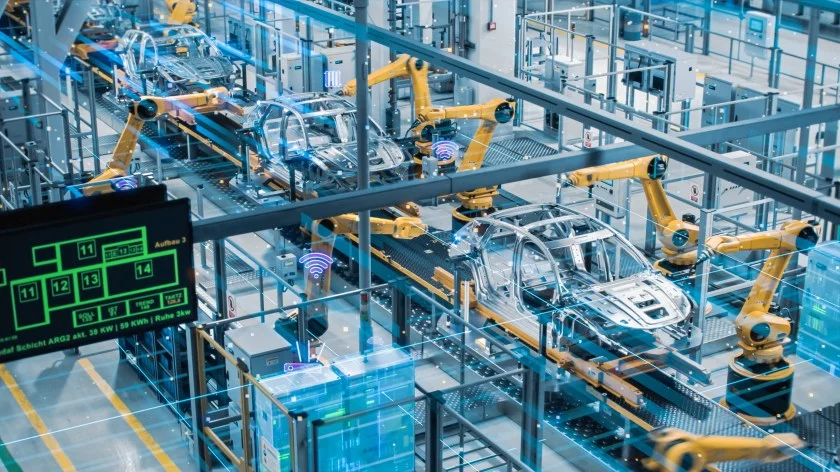
A production instruction can specify a machine setting and a sequence of steps. It may not capture how a particular material behaves, what changed during the previous shift or which small deviations have signaled trouble before. An experienced operator brings that context to the task. When that judgment remains with one person or one plant, the organization has a knowledge bottleneck.
Industrial intelligence is the combination of that human expertise with a manufacturer’s operating practices, production data and understanding of its business. Making it useful at scale means preserving the context behind the information, then putting it within reach of the people making engineering, maintenance, planning and production decisions.
Make experience usable across the organization
Moving a production record from one system to another doesn’t automatically transfer the knowledge needed to interpret it. An engineer considering a process change needs to know which equipment configuration produced the results, what quality requirements applied and what trade-offs operators made. Those details help distinguish a useful lesson from a number that only appears relevant.
Connecting operational data with procedures and workers’ expertise can give teams a more complete basis for decisions. An insight from one plant may help another team address a similar problem; maintenance findings may inform engineering choices; and production experience may sharpen planning. The larger opportunity is to let more people contribute to improvements because they can work with more of what the organization already knows.
That information also needs to reach the point where the physical work happens. Manufacturing depends on materials, machines and products, so intelligence that stops at a dashboard has limited effect. Physical AI describes systems that can perceive conditions in the physical world, reason about them and take action. Connected machines and processes can give those systems a clearer view of operations; AI agents can then help identify patterns, anticipate problems and suggest responses.
Connect perception to a controlled response
Imagine a robotic handling station receiving parts in slightly different positions. Vision can estimate where each part is, while a model informed by the material and task can help select a suitable movement. Controls can then make an adjustment within validated operating limits. The useful step is the full chain: detect the variation, interpret it in context and respond appropriately.
A reported example comes from Toyota Industries, which connected data that had previously been fragmented across its paint shop. The resulting context helped engineering and operations teams investigate what was driving defects. Toyota Industries reports that analysis cycles dropped from five days to less than four hours, and a pilot reduced relevant paint defects by about 25%.
The figures point to a broader operational lesson: detecting a signal is only part of solving a production problem. Teams need to understand why a defect is occurring and have enough time and context to act before the result is fixed. Data can describe what is happening; industrial intelligence helps connect that evidence to the constraints, experience and judgment involved in deciding what to do.
Simulation can help teams examine possible changes before applying them to production equipment. A digital environment gives manufacturers room to explore how a proposed action might affect a process. It doesn’t replace validation on the physical line, but it can help teams learn before production becomes the first test.
Systems that act on equipment also need clear operating boundaries. Manufacturers need to define which changes a system may make, connect it reliably to relevant equipment and keep records of decisions and actions. Workers must be able to recognize uncertainty, intervene and bring equipment to a safe state. Trust depends on these working arrangements as well as on a model’s output.
Equip workers to solve a wider range of problems
Automation can take on suitable repetitive or physically demanding tasks. AI systems can also help workers navigate large bodies of information and respond to changing conditions. The benefit depends on how these capabilities fit into real work: people need training, time to learn and a meaningful role in shaping how the systems behave.
Rockwell Automation offers an example from its Singapore plant, where technicians use a maintenance copilot that draws on manufacturing data, machine manuals and knowledge captured from experienced workers. The company says the system cut the time new workers need to learn troubleshooting across hundreds of machines from nine months to three.
That kind of tool can help technicians find relevant guidance faster, while preserving access to know-how that might otherwise be difficult for a new employee to acquire. Engineers may be able to compare more process options before committing to a change. Operators could also help improve system responses, rather than repeatedly handling the same exception by hand.
The value, then, isn’t simply adding AI to a factory. It’s extending what workers can understand and do by making the organization’s knowledge easier to find and apply. Equipment investment matters, but so do skills development and workers’ participation in designing the processes around that equipment.
Build growth from what operations learn
Manufacturers face a practical scaling problem: how to improve output, quality and capacity without allowing operational complexity to grow at the same pace. Connected expertise and data can help turn experience into capabilities that spread across teams and sites. Physical AI adds the possibility of carrying those capabilities into the process itself, where systems can respond to changing conditions within defined limits.
That outcome won’t come from automation alone. It depends on whether manufacturers can connect information to the context people need, give workers a way to oversee system behavior and learn from the results. The companies that make those connections may find that the strongest source of growth is already present in their operations: knowledge that can now travel further and inform more decisions.
This content was produced by Microsoft. It was not written by MIT Technology Review’s editorial staff.


