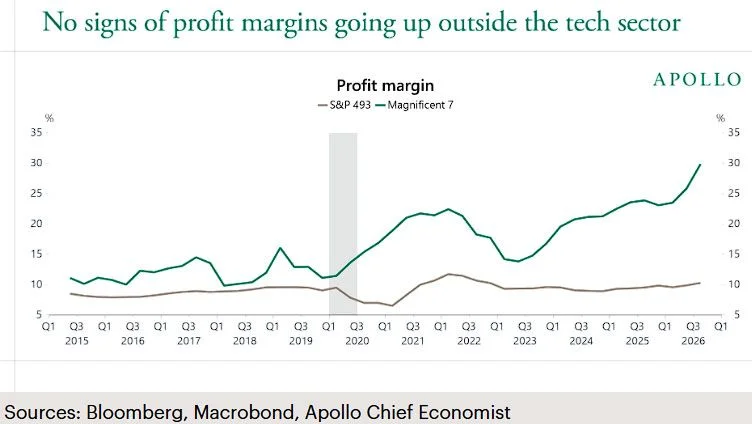
AI’s commercial returns are showing up most clearly in the companies selling the technology. Across the rest of the S&P 500, Apollo economist Torsten Slok’s analysis found no comparable rise in revenue per worker or profit margins—a gap that puts pressure on customers and suppliers to show that growing AI bills deliver business value.
Slok shared the findings on October 24. Revenue per worker and margins had risen among the Magnificent Seven technology stocks, while those measures stayed flat across the other 493 S&P 500 companies. His assessment was blunt: “Despite massive investments and widespread hype around artificial intelligence, the technology has delivered zero financial payoff to corporate America outside of tech.”

- The data center cooling state of play
- The custom AI ASIC state of play
- America’s AI chip rules keep changing — and the rest of the world is paying the price
- GTC 2026: Ian Buck press Q&A transcript — VP of Hyperscale and HPC speaks out on shelving CPX and shipping LPU decode this year
- Demand for data center CPUs has surged, and AI agents are responsible
Usage can grow faster than the payoff
For businesses, the cost of AI often scales with use. Many providers charge by token, so bills rise as employees send more requests or agents take on longer, more complex tasks. Slok said established companies are starting to treat token spending as a cost center. Venture-backed firms are spending more, while other businesses have reason to choose less expensive models when they meet the need.
That creates a test for AI vendors: customers must see better productivity, more revenue or lower operating costs to justify continued spending. If usage costs climb without measurable gains, AI can put pressure on the very margins companies hope it will improve.
Slok also argues that business outcomes depend on factors models don’t readily account for. “AI does not understand accountability, trust, culture, unwritten rules, ethical trade-offs or fairness, all of which shape reputational risk and ultimately drive revenue growth and profit margins,” he wrote. He sees the S&P 493 as the real test of AI’s broader economic impact, and so far, he said, there’s no evidence of improving revenue growth or margins outside the technology sector.
Fintech adoption meets trust and cost constraints
A similar divide appears in India’s fintech industry. A PwC India survey reported by Business Standard on September 11 found that 84% of respondents had yet to record measurable financial returns from AI investments. Even so, 48% named proprietary intelligence as a leading strategic priority.
Respondents expect customer experience to be the biggest driver of AI agent adoption over the next three to five years, cited by 30%. Cost reduction and productivity gains followed at 22%. But scaling agentic payments faces practical obstacles: 41% pointed to customer trust and adoption, while 33% cited fraud, security and risk management.
Agents can take on multistep work across business systems, extending AI beyond answers to prompts. That broader access also means more opportunities for costly processing and for errors or misuse. Nvidia has introduced its Open Agent Safety Platform, a hardware and software stack intended to help businesses constrain agents and block harmful actions.
Token bills are already prompting companies including Microsoft, Meta and Amazon to rein in AI usage as employee adoption and agent workloads grow. OpenAI CEO Sam Altman has called token costs a “huge issue” for customers seeking better value. Meanwhile, Amazon, Google, Meta and Microsoft are committing substantial sums to the data centers, chips and power that support AI workloads.
The next measure of AI’s business impact will be whether companies can turn that infrastructure and usage into results they can track. Until revenue, productivity or margins improve beyond the technology sector, rising demand will remain clearer in suppliers’ sales than in customers’ financial performance.


