Cadence is putting specialized AI models inside its chip design agents, aiming to make complex engineering workflows more efficient and more tailored to customer designs. Its new Maestro portfolio combines domain-specific models, model routing and customer post-training. Cadence reports initial gains of up to 30% in quality of results and up to five times the token efficiency of a general-purpose foundation model, though it hasn’t defined the quality metric behind the first figure.
The first Maestro models are slated for select early-access customers in Q4 2026. Customers will be able to run them in Cadence’s cloud, public cloud environments or customer-controlled on-premises deployments. Cadence also plans to let customers post-train the models on their own proprietary data, designs and workflows. In a discussion with Tom’s Hardware Premium, Rob Knoth, senior group director of strategy and new ventures, and Paul Cunningham, senior vice president and general manager, described the system’s design and its place in Cadence’s growing AI portfolio.
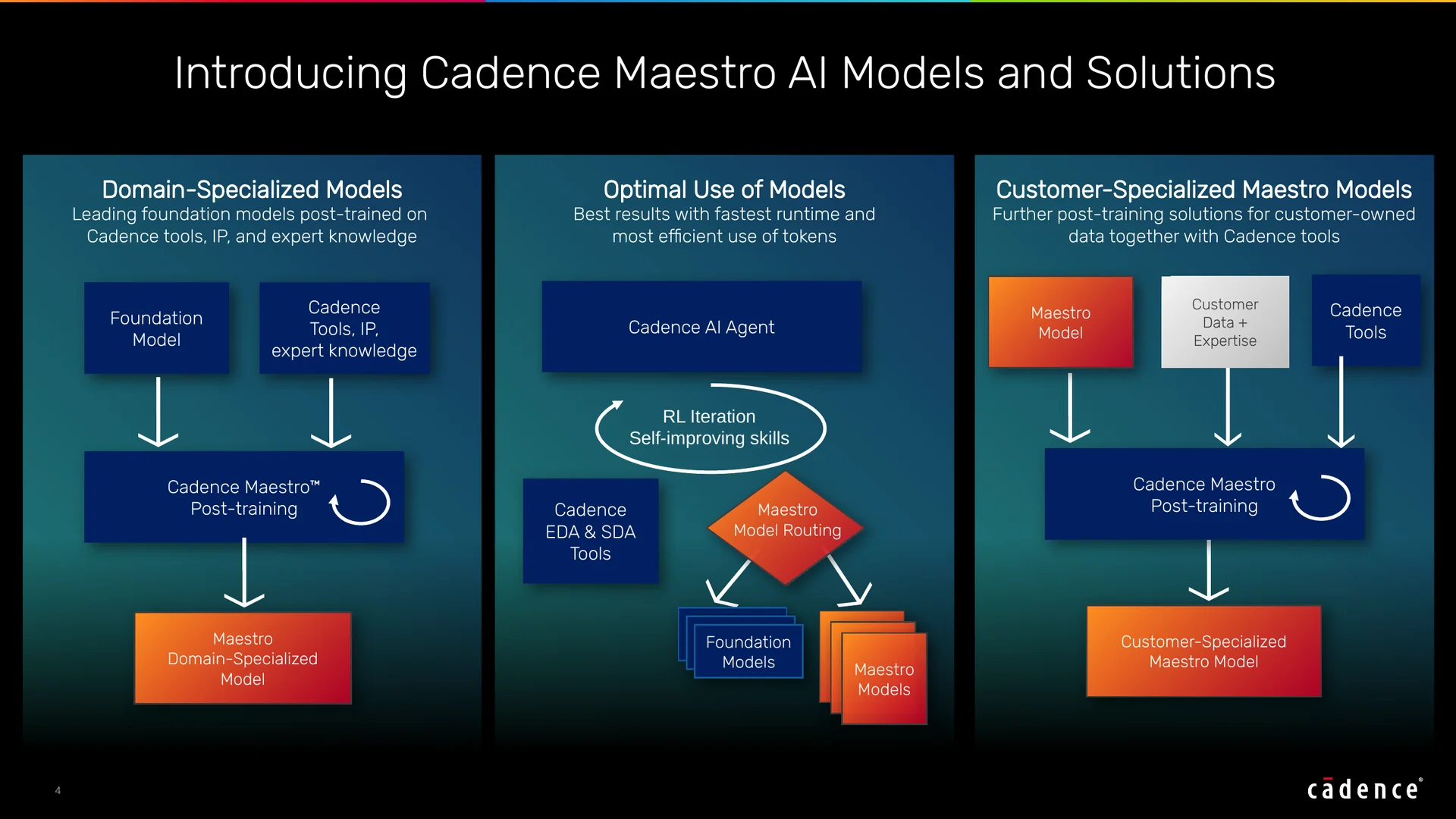
Model choice is part of the efficiency strategy
Maestro works with Cadence’s AI Super Agents. Those agents interpret design intent, break work into tasks and coordinate different models and tools. The aim is to match each step to a model suited to the job, rather than spending the same amount of language-model compute on every part of an engineering workflow.
“You don’t need to drive to Safeway in the jet engine,” Cunningham said, describing the case for routing work between models and electronic design automation (EDA) tools. Cadence attributes Maestro’s token savings to balancing calls to its EDA and system design automation tools with calls to large language models. For chip design teams, lower token use could mean lower compute costs, though Cadence hasn’t said whether its reported efficiency gains will reduce customer bills.
The approach also addresses a practical problem with agent-based engineering: tool calls can take far longer than a language model’s response. Knoth previously told Tom’s Hardware Premium that a tool call might take hours or days to return a result, while AI training loops typically run on a scale of minutes. Maestro’s reinforcement learning process uses Cadence’s deterministic solvers to assess model outputs against engineering objectives, constraints and ground truth, then feeds those results back into the models.
Maestro is built from post-trained language models, trained decision models and agent skills, and can be combined with frontier and open-weight models. Cadence has named Nvidia’s Nemotron among the models in the mix. Customers can use Cadence’s fine-tuning tools to run post-training themselves, potentially on their own GPUs and networks. Cunningham said Nemotron was delivering “really solid results” and improving quickly.
Early performance claims need context
Cadence’s headline figures—up to 30% higher quality of results and up to five times the token efficiency—are initial comparisons against a general-purpose foundation model. The company says that baseline is the open-source model from which Maestro was developed, but it hasn’t identified the model by name. Cadence described it as one of the leading open-source models, competitive with commercial frontier models.
In chip design, quality of results often refers to power, performance and area. Cadence hasn’t specified what its 30% figure measures, so the number is difficult to compare with other engineering results. The token-efficiency claim is more direct, but its practical value will depend on the tasks being run, the models selected and the cost structure customers face.
Maestro also marks a different approach from Synopsys’ GPT-Synopsys. That specialized model is designed to operate Synopsys tools on OpenAI-hosted infrastructure, and the companies say customer data won’t be used to train it. Cadence, by contrast, gives customers the option to post-train Maestro on their own designs and workflows, as well as to run it on infrastructure they control.
Both companies are responding to the rising cost of running agents. Cunningham said agent costs have “really started to explode,” and argued that moving more iteration into model weights is a natural next step. The difference in deployment and training choices gives engineering organizations distinct ways to manage where design data goes and how much control they retain over model adaptation.
Deployment and security shape adoption
Cadence says it’s working with Nvidia on an integration with Nvidia’s OpenShell Reference Architecture, which Nvidia introduced with both Cadence and Synopsys named. The work is intended to support security controls for agents, including sandboxing. For customers handling proprietary chip designs, deployment flexibility and protections around agent activity will matter alongside model accuracy.
Synopsys has described a similarly broad deployment menu for its Autopilot platform, allowing customers to select commercial, open-source or fine-tuned language models across Synopsys-managed and customer-managed environments, in the cloud or on premises. Cadence’s Maestro offering puts customer post-training and infrastructure control at the center of its pitch, while GPT-Synopsys currently relies on OpenAI-hosted infrastructure.
Maestro arrives amid a wider agent rollout
Cadence has been building its agent portfolio since acquiring ChipStack, an agentic verification startup, in November 2025. The company now places Maestro beneath four AI Super Agents. Its portfolio includes ChipStack for design and verification, ViraStack for custom and analog design, InnoStack for digital implementation, and AuraStack for PCB and advanced packaging workflows.
Customer activity is growing, though engagements and early access don’t establish broad availability. During Cadence’s July 2026 earnings call, CEO Anirudh Devgan said ChipStack had more than 20 customer engagements and ViraStack more than 25. Socionext said it was applying InnoStack, while Silicon Labs has credited ChipStack with speeding up debugging. Both companies are watching Maestro’s development.
Cadence has made a series of performance claims across the portfolio. It said ChipStack reached Level 5 autonomy in June 2026 and reported more than 40 times faster RTL validation cycles in Nvidia’s deployment. For its September RTL Generation Agent evaluations, Cadence reported average reductions of 24% in area and 18% in power compared with code produced by a foundation model alone. Those figures come from different products and evaluations, so they shouldn’t be read as a single measure of Maestro’s performance.
The company has not announced a general-availability date for Maestro. Its first models are expected to reach select early-access customers in Q4 2026, with roughly a dozen engagements underway. Synopsys and OpenAI have also begun early technology engagements for GPT-Synopsys; Synopsys has separately said its AgentEngineer portfolio and Autopilot platform are targeting general availability by the end of 2026. The products remain in development, and customer results will determine how much of the early promise carries into production.
Cunningham said he hopes to share “more case studies, more quantifiable benefits” during Q4. That evidence will help customers judge the reported gains against real workflows, where design quality, runtime and infrastructure choices all shape the result. Cadence’s bet is that chip design expertise belongs inside the agents and models that run engineering tools. The next meaningful signal will be whether customers can show repeatable improvements on their own designs.
For background on the broader push toward autonomous chip design, see our review of agentic AI in chip design tools. Cadence first previewed Maestro’s ingredients to Tom’s Hardware Premium in September, describing reinforcement learning loops, domain-specific post-training of open-weight models and model routing.


