AMD’s EPYC 9996 is a 256-core server processor, but its early single-threaded results point to something desktop buyers may care about: Zen 6c appears to outperform Zen 5 by a wide margin at the same clock speed. The comparison is preliminary, and the server chip’s configuration complicates direct claims about IPC. Still, its lead across several Geekbench 7 workloads makes this an intriguing first glimpse of AMD’s next CPU generation.
A matched-clock comparison with caveats
Enthusiast and occasional leaker HXL (@9550pro) spotted a Geekbench 7 result for the EPYC 9996. Russian enthusiast “three twenty six” (@326powah) then compared it with a Ryzen 7 9700X, running both processors at 4.1 GHz. That clock match helps isolate per-core performance, though it can’t remove differences in cache, memory, system configuration, or processor design.
The EPYC 9996 packs 256 Zen 6c cores across eight “Monarch” chiplet dies, with 32 cores per die. Each die reportedly has 128MB of L3, split between two 64MB domains serving 16-core clusters. That works out to 4MB of L3 per core, the same ratio AMD has maintained since Zen 2. The 9700X also has 4MB per core, with eight Zen 5 cores and 32MB of L3 in total.
The server processor’s full cache totals 1GB. It also has a 1024-bit memory bus, reportedly supporting speeds up to 12,800 MT/s and bandwidth of 1.64 TB per second. Those resources could affect some benchmark results, particularly latency-sensitive ones. But the comparison used single-threaded tests, and the 9700X’s DDR5-6000 CL34 memory should be adequate for these relatively light workloads.
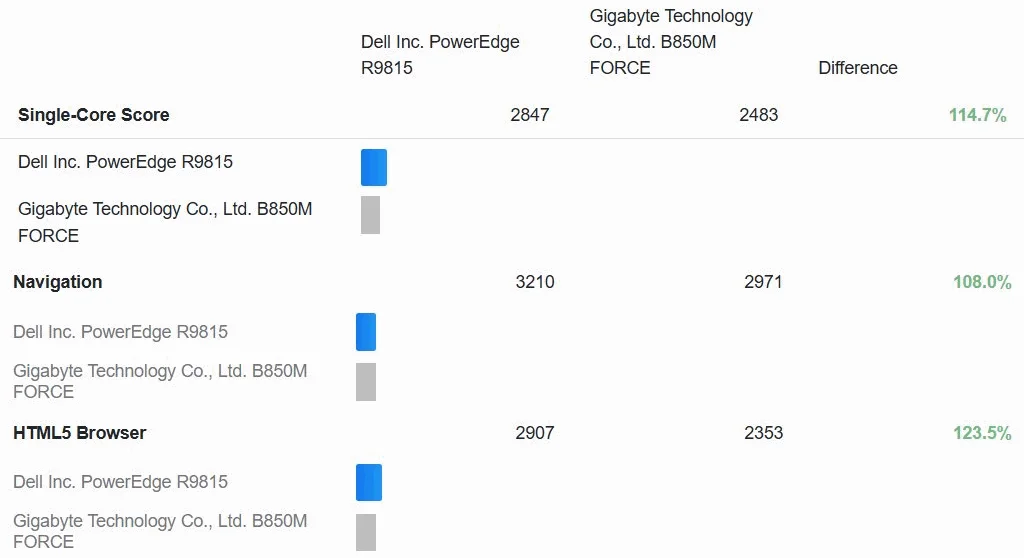
Zen 6c leads across several workloads
On Linux, the EPYC system scored 2,847 in Geekbench’s single-threaded test, compared with 2,483 for the Ryzen 7 9700X. The Windows results also favored the EPYC chip, though the gap was larger there: the 9700X scored 2,318. The Linux comparison is the more useful reference for looking at performance by workload.
The largest reported Linux advantage was 24% in the HTML5 Browser test, where the EPYC’s large L3 cache may have helped by reducing memory latency. Other gains are harder to attribute to cache alone: the server chip was 19% faster in asset compression, 21% faster in video encoding, and 17% faster in photo editing. Those results suggest Zen 6c may bring meaningful per-core improvements, though one test run can’t establish how much comes from the architecture itself.
Geekbench’s workloads also put the results in context. The benchmark generally makes limited use of SIMD instructions, and this test is marked AVX2, so it doesn’t exercise the AVX-512 units available on both processors. Much of the measured performance instead reflects integer operations and memory behavior. The Zen 6c lead is notable precisely because it shows up without leaning heavily on vector throughput.
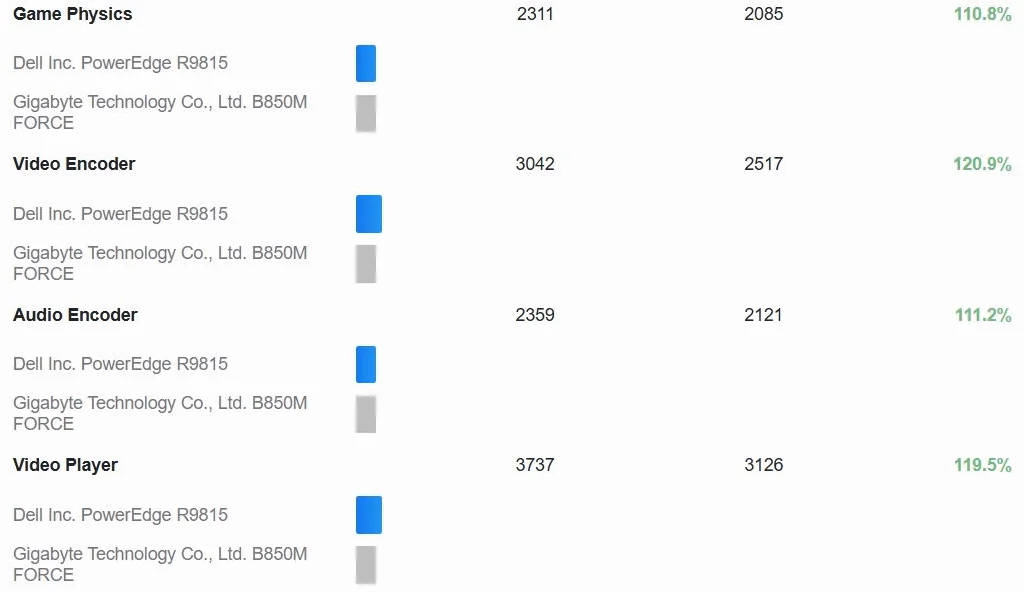
What the result may mean for desktop Zen 6
These numbers don’t prove that Zen 6 has 15% higher IPC than Zen 5. The EPYC 9996 uses Zen 6c, a density-focused core design built to fit more cores into a given area, with less emphasis on reaching high clock speeds. Its 4.1 GHz test frequency is modest, and its cache and server platform differ substantially from a desktop system.
That distinction matters because desktop processors are expected to use a different Zen 6 core. The EPYC benchmark can’t tell us exactly how those chips will perform, but the per-workload gains are encouraging. Zen 5 offered a relatively small IPC increase over Zen 4, while reports about Zen 6 have pointed to both stronger IPC and higher clock speeds.
AMD has confirmed that upcoming processors will support the AM5 socket, with a desktop launch expected early next year. The next useful evidence will come from tests of desktop Zen 6 chips under comparable conditions. For now, the EPYC 9996 suggests AMD’s next architecture could deliver a more substantial per-core step than Zen 5 did.