
PeakVision AI is betting that enterprise AI will be shaped as much by where work runs as by which model powers it. Its approach centers on local computing and agents that carry out a user’s goal across tasks, a pitch aimed at companies seeking to contain costs and keep sensitive data on site.
That focus also sets the startup apart from AI platforms built for large corporations with dedicated deployment teams. PeakVision is aiming at small and medium-sized businesses, which face similar technical and data challenges but have less money to address them.
An operating system built around tasks
Founded in 2024, PeakVision AI started with two barriers to business adoption: deploying AI is difficult, and companies worry about data security. Co-founder and CTO Liangyu Nie described those concerns to TechNode as the problems behind the company’s product direction.
PeakVision is assembling a stack that combines locally deployed computing, its FengKan AIOS software, and AI-agent services. Rather than asking people to navigate separate applications, the system is designed around the work they want completed. “You don’t need to download different apps. You just tell AI what you want in a chat box, and AI does it for you,” Nie said.
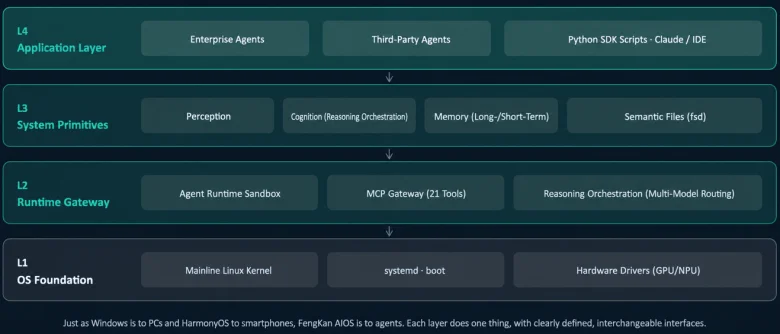
The product thesis is a shift in how enterprise software is organized: users express intent, then agents coordinate the steps. PeakVision plans to open-source FengKan AIOS by the end of October.
The company established its headquarters in Hangzhou in March 2026 and received RMB 15 million in government R&D support. It delivered its first enterprise systems and closed an initial funding round in May, then raised tens of millions of yuan in a second round in August.
A business model built for repeat deployments
PeakVision earns revenue through hardware, subscriptions, and customized enterprise deployments. Its longer-term challenge is turning tailored projects into repeatable packages that can serve businesses with similar needs.
FengKan AIOS works with third-party hardware, and the company is taking a selective approach to sharing its Skill ecosystem. Nie said customers’ end-user Skills may encode proprietary workflows and will remain untouched. More broadly useful Skills developed by partners and forward-deployed engineers could be released to the market.
PeakVision is testing this approach through an FDE academy launched by Shanghai Sixunited Intelligent Technology with support from Advanced Micro Devices (AMD). AMD contributes computing equipment, technical toolchains, and project resources. The startup also works with chipmakers during product development to improve performance and manage costs; a partnership with ChangXin Memory Technologies is intended to reduce memory costs.
SMBs are the target market
Where enterprise AI providers such as Wonderful focus on large organizations, PeakVision is pursuing smaller businesses. Nie’s argument is straightforward: smaller companies encounter the same cost, complexity, and data-control issues, but can afford fewer people and less infrastructure to solve them.
“I believe small and medium-sized businesses around the world face the same challenges,” Nie said. “They have the same pain points as large enterprises, but one additional problem: they simply cannot afford to spend as much.” PeakVision says it uses lower-cost hardware from China’s supply chain to make deployments more affordable and easier to adapt for similar customers.
The company is also exploring international markets. It has received distributor interest in the U.S., Israel, and Saudi Arabia, and is considering Southeast Asia, Latin America, and Africa. Local AI may suit businesses in areas where internet access is limited or unreliable, though the company’s expansion plans remain at an exploratory stage.
Early examples in design and financial analysis
PeakVision cites manufacturing work as evidence of how agents could change day-to-day processes. At a lifeboat manufacturer, it says, agents cut a product-design cycle from one month to one week. At a yacht maker, AI-generated designs shifted engineers’ time from drafting proposals toward reviewing and approving them.

Nie also said the company has built tools for anti-corruption authorities analyzing financial records and for police tracing funds associated with fraud. These examples point to a broad range of potential uses, although the source provides no further detail on deployments or measured outcomes in those areas.
Human review remains part of the plan
PeakVision aims to reach 80 to 100 enterprises across 10 industries by 2027, with the longer-term goal of making FengKan AIOS a widely adopted enterprise platform. Whether it can scale will depend on turning custom work into products that smaller customers can deploy and afford.
Nie expects people to retain responsibility for judgment even as agents take on more tasks. That shift could still reduce staffing needs: “For an employer, tasks that once required at least five people could be handled by just one,” he told TechNode. The practical measure of PeakVision’s approach will be whether local agents can deliver those efficiencies while giving businesses enough control to trust their output.