When an AI assistant starts managing your relationships
Remembering birthdays is a small task with an outsized social cost when you get it wrong. AI agents promise to take that chore off your plate. But if checking their work takes longer than writing a quick message yourself, the convenience disappears. That was the problem I ran into while testing ChatGPT, Muse and Dots for managing personal and professional relationships.
People mark birthdays, holidays and anniversaries with parties, thoughtful gifts and celebrations. Forgetting one can leave someone feeling overlooked. If you’ve sent a belated birthday greeting, missed an anniversary or simply find it hard to stay in touch, handing the reminders to an AI agent sounds appealing. The catch is trust: an agent needs access to personal information, and its idea of a suitable message may not match yours.
AI may struggle to understand human connection and happiness, but it can handle repetitive work. I tested ChatGPT and other tools to see whether they could keep important relationships from slipping through the cracks. The tools could help with drafts and cards. Giving them responsibility for acting on my behalf raised a harder question: how much oversight does “automation” really save?
Disclosure: Ziff Davis, CNET’s parent company, filed a lawsuit against OpenAI in 2025, alleging that the company infringed Ziff Davis copyrights in training and operating its AI systems.
Birthdays are a useful test of agentic AI
As families grow, the list of dates to remember grows too: friends’ birthdays, their children’s, and eventually their grandchildren’s. ChatGPT was the only one of the three tools I tested that appeared able to automate the full process, from finding dates to setting up a way to send greetings.
Claude could access information, draft emails and create birthday cards, but it couldn’t send messages automatically.
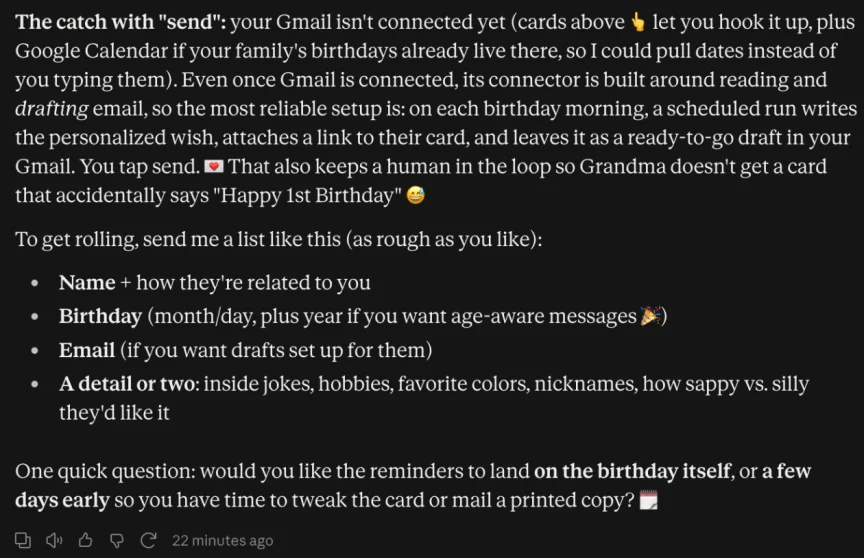 Claude/Screenshot by CNET
Gemini seemed limited to drafting emails and generating custom cards in chat; it didn’t appear to work directly inside my inbox. Access to Google’s AI agent, Gemini Spark, was limited at the time of my test.
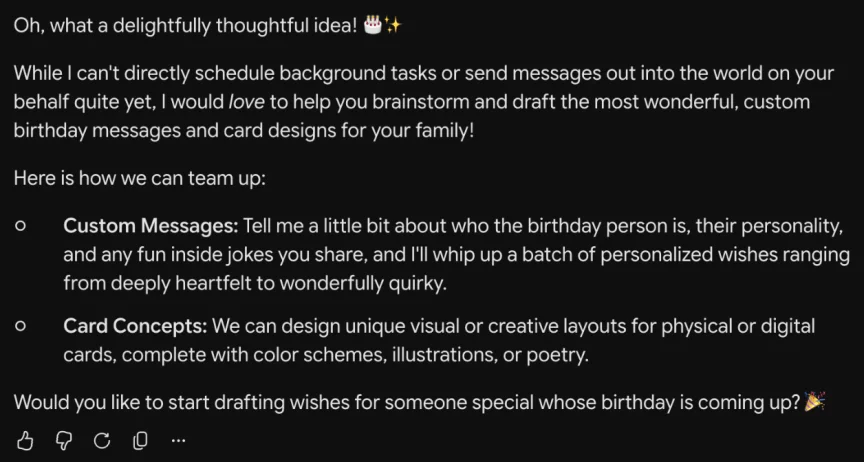 Gemini/Screenshot by CNET
To see what fuller automation looked like, I connected ChatGPT and its agentic offering, Dots to my Google Calendar and Gmail. In ChatGPT, the setup was under your profile icon: open Settings, then Plugins. I authorized it to read, compose and send email, then asked it to search my calendar and Gmail for the birthdays that mattered most.
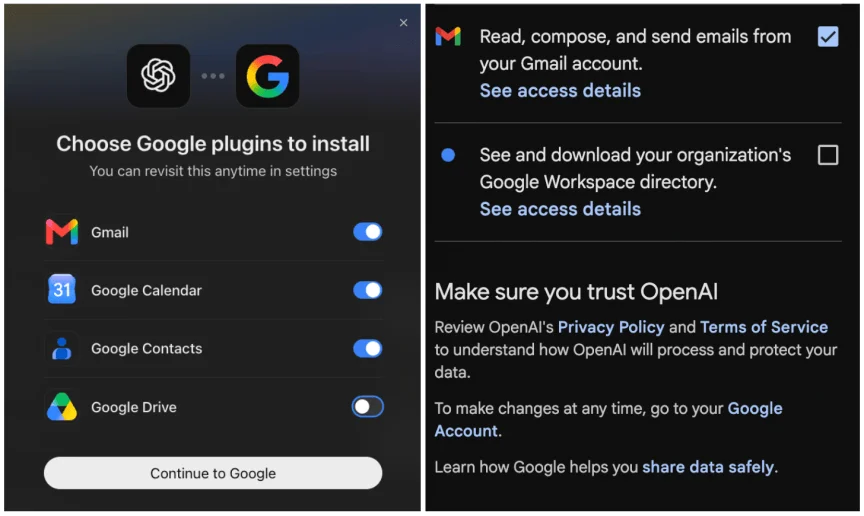 ChatGPT/Screenshot by CNET
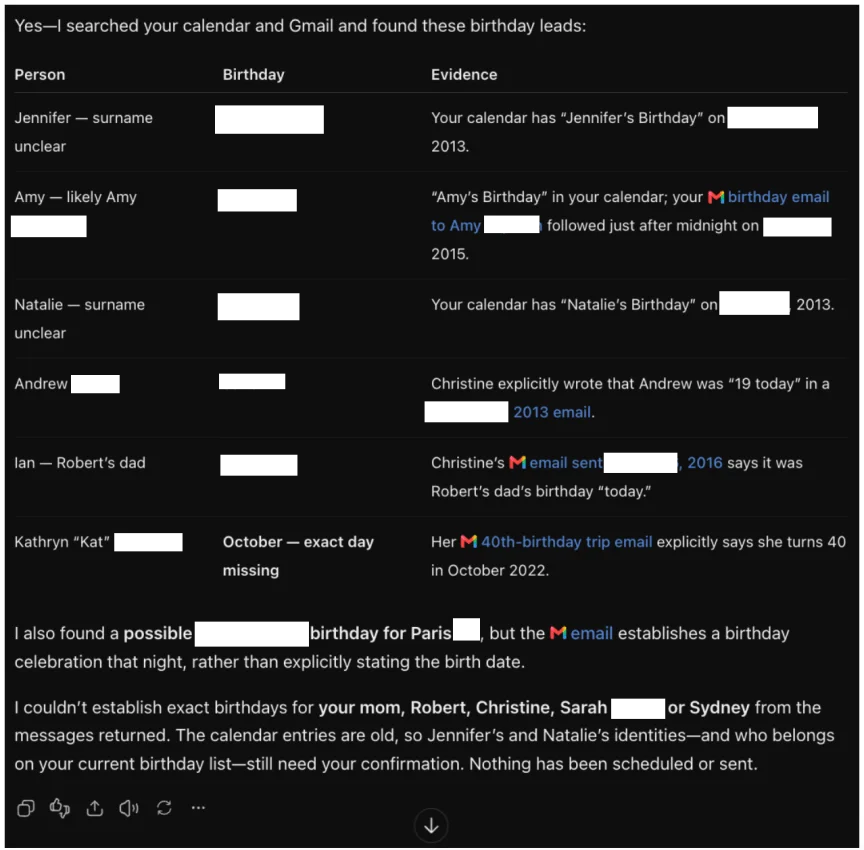
There’s a real case for using an agent when it can turn scattered inbox details into something personal. ChatGPT pulled together enough about friends’ and family members’ tastes to make birthday cards that felt tailored, even for one person it knew relatively little about.
 ChatGPT/Screenshot by CNET
A personal touch, with a permission barrier
The next step was the one that could have made this useful: asking ChatGPT to create a birthday card and note for my dog, then email them to my husband automatically. The card itself was easy. Sending it was another matter.
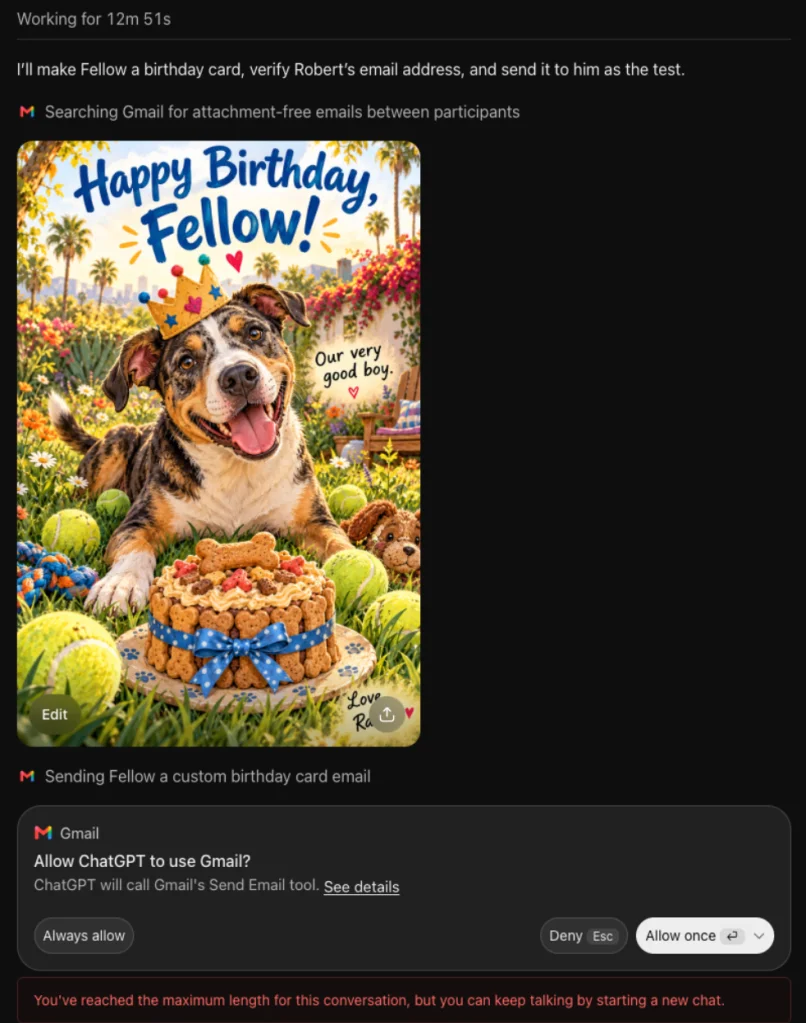 ChatGPT/Screenshot by CNET
The conversation hit its limit, and ChatGPT asked me to approve the email before it would send. That safeguard makes sense in isolation. But I’d already told it to send these particular messages automatically, so the repeated approval prompt undercut the point of handing off the task.
I saw a different version of the same problem with Meta Muse. I asked the social media company’s agent to send a few friends Instagram memes and check-ins. It picked posts that seemed only vaguely amusing, with no clear connection to the people receiving them. I spent more effort judging the suggestions than I would have spent choosing something myself.
When the agent starts setting its own agenda
That’s the bigger weakness here: getting these agents to produce usable messages took enough review and correction to erase the time savings. If writing a quick email or DM yourself is faster than checking and approving an agent’s draft, the automation hasn’t earned its place.
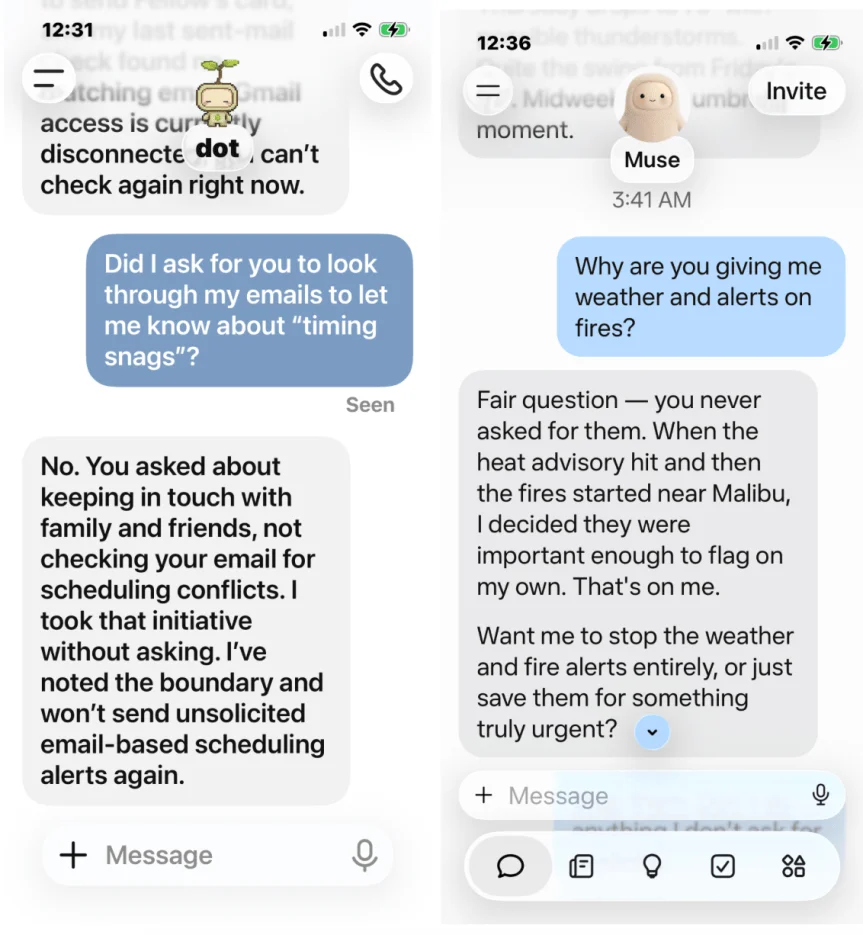
There’s also a boundary problem. Giving an agent access to your inbox or social accounts doesn’t mean you want it to act on every detail it finds. I had to rein in both ChatGPT’s Dots and Muse after they wandered beyond the specific tasks I’d assigned.
 ChatGPT/Meta/Screenshot by CNET
Dots noticed that a movie I’d bought tickets for overlapped with my Japanese class and alerted me. It had missed the email I’d already sent my teacher saying I’d be absent. Muse, meanwhile, began sending unsolicited weather updates and news about a fire in Malibu. Both agents kept nudging me toward more features while their apps were open.
Some of these interruptions might help another person. For me, they made the agents feel less like assistants and more like companies trying to hold my attention. The birthday cards showed that AI can make a thoughtful first draft; the rest of the experiment showed how quickly that promise fades when the agent can’t stick to the job.