A foldable phone needs more than a hands-on review
CNET has put Apple’s iPhone Duo into a custom machine that will repeatedly open and close the phone, tracking how its hinge and two screens hold up. The test is built to run at up to 900 folds an hour, giving CNET a way to study wear over time that a reviewer simply handling a phone can’t provide. The team bought the Duo after waiting more than three hours at an Apple Store in Louisville, Kentucky. By Friday afternoon, it was installed in CNET’s lab, where Lab Director Matthew Murray says he has spent months overseeing the machine’s design and test method in anticipation of Apple’s long-rumored foldable. CNET calls the rig the **Fold-a-Phone**. Its testing of Samsung’s Galaxy Z Fold 8 is also underway, setting up a direct comparison. That comparison matters because Apple hasn’t disclosed how many folds the Duo is designed to withstand. Manual testing can reveal plenty about daily use, but it can’t systematically measure the forces on the hinge and the magnets that hold the phone shut. CNET’s machine is meant to add that data to Senior Technology Reporter Abrar Al-Heeti’s [review of the iPhone Duo’s pros and cons](https://www.cnet.com/tech/mobile/iphone-duo-review/). The results should help readers judge the phone’s durability alongside its day-to-day strengths and shortcomings. Apple’s arrival also gives the test wider relevance. Samsung’s first [Galaxy Fold went on sale in the US in September 2019](https://www.cnet.com/tech/mobile/samsung-galaxy-fold-now-on-sale-in-the-us-for-1980/), while Motorola and other manufacturers have explored different foldable designs, including a [trifold phone CNET first saw in 2019](https://www.cnet.com/tech/mobile/this-new-foldable-phone-design-makes-the-galaxy-fold-look-downright-boring/). CNET’s mobile team, including Al-Heeti and Editor at Large Andrew Lanxon, has argued that the Duo’s arrival could help [make foldable phones feel more legitimate to mainstream buyers](https://www.cnet.com/tech/mobile/i-need-apples-iphone-duo-to-get-me-excited-about-foldables-again/). That’s a meaningful shift—but whether Apple’s entry changes how people use or trust foldables remains to be seen. CNET says it will publish updates and comparisons as testing continues. Readers can also follow the process during [CNET’s iPhone Duo livestream on YouTube](https://www.youtube.com/channel/UCOmcA3f_RrH6b9NmcNa4tdg), Monday from 1 to 5 p.m. ET, and ask questions about the test.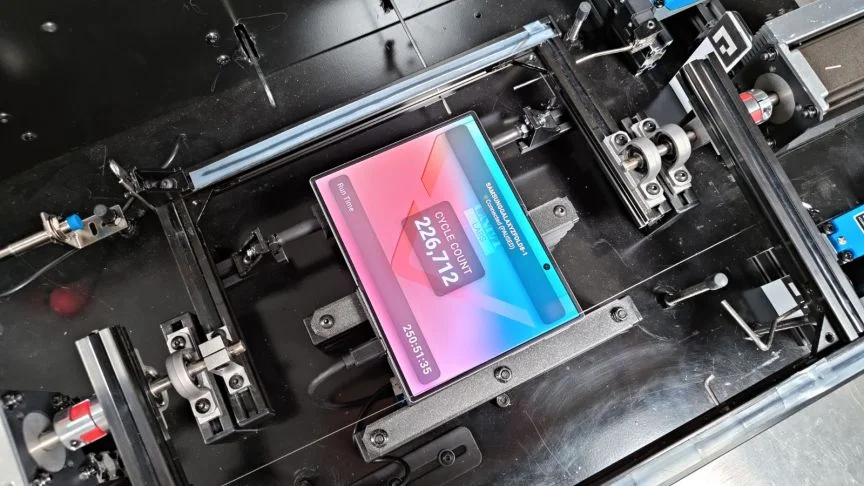
Testing for ordinary use
Most current [foldable phones](https://www.cnet.com/tech/mobile/best-foldable-phones/) are rated for 200,000 to 500,000 folds. CNET designed the Fold-a-Phone to handle book-style and flip-style devices across different sizes and hinge orientations; it wasn’t built for trifold models, which create a different engineering challenge. The machine is also intended to reflect how people actually use a phone. A typical cycle includes opening it, using an app or watching a video, then closing it and putting it away—not folding it continuously at maximum speed. CNET says that more measured approach avoids unnecessary strain on the hinge and excess heat, making the test more representative of everyday use. For a young product category, that distinction matters. A fast count of folds would be easy to headline, but the conditions behind the count determine what it tells us about a phone’s useful life.Related: iPhone Duo review · Apple Store lines for the iPhone Duo · How CNET tests phones · Galaxy Z Fold 8 review
How the Fold-a-Phone works
A four-second folding cycle is the compromise that makes this test practical: the phone takes one second to begin opening, another to reach fully open, then one second to start closing and one more to shut completely. Each cycle counts as one fold, repeated until the hinge or display fails. That pace keeps the mechanism moving quickly while giving the test a workable rhythm. The machine uses standard, off-the-shelf parts. Two armatures handle the opening and closing, each driven by an industrial stepper motor. Software on a connected computer adjusts motor torque at each step to move the phone while protecting it. Proximity sensors check the armatures’ positions; if one doesn’t register correctly, the machine stops.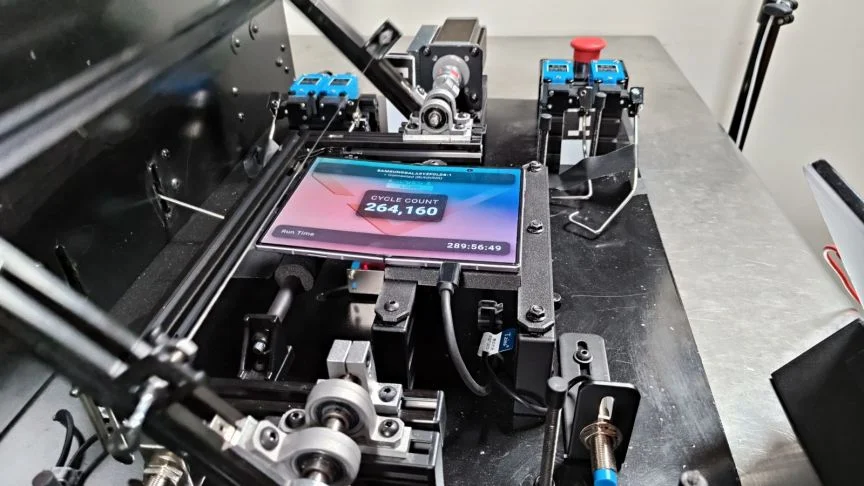 Matthew Murray/CNET