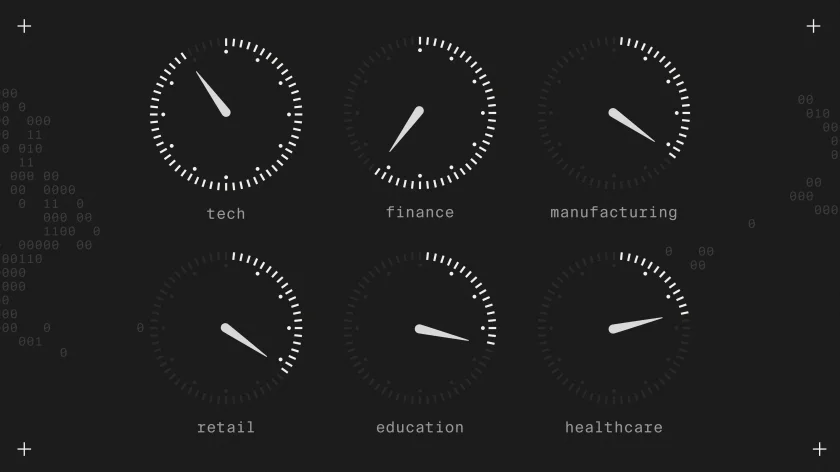
AI adoption is moving at different speeds across industries, and that gap offers a useful preview of how work may change. TripleTen survey data puts tech at the front and finance close behind, while healthcare and education show lower early exposure. The pattern looks less like a race than a sequence: industries take up AI as their workflows, staff roles and operating constraints allow.
Adoption follows the work
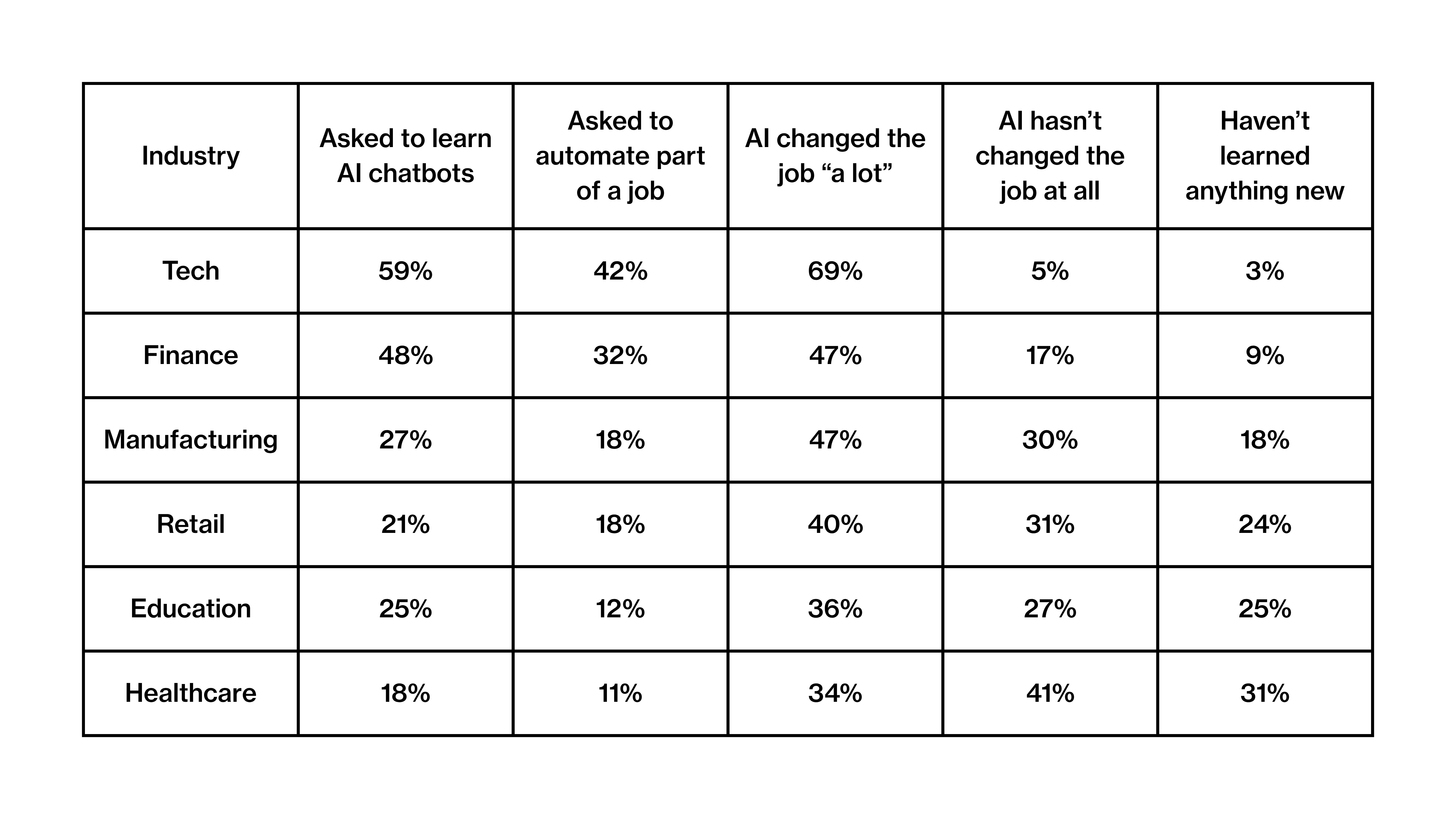
TripleTen’s survey shows that 48% of finance workers have been asked to use AI chatbots, while 32% have been asked to automate parts of their work. Those figures suggest that knowledge work with recognizable, repeatable tasks is already creating clear entry points for AI.
Healthcare and education report lower chatbot exposure: 18% of healthcare workers and 25% of education workers have been asked to use them. Each sector includes a broad mix of administrative staff and people whose work is hands-on, clinical or instructional. Introducing automation into these settings takes more care, especially when tools affect human-facing operations or sit within compliance-heavy workflows.
Figure 1: AI adoption remains uneven across industries, with uptake rising outside tech.
Source: TripleTen, 2026
AI changes the skills mix
Across the industries surveyed, 79% of workers said they had been asked to learn at least one skill they didn’t previously have. Skills taking shape in tech can apply well beyond software teams: hospital systems may use them to manage patient logistics, while school districts can apply them to administrative reporting.
One capability deserves more attention: checking whether AI output is correct. Just 30% of managers and business owners rated that skill an absolute must, placing it sixth among seven skills. Yet it’s the check that can catch errors before they affect decisions or operations. Subject expertise matters here; workers need a sound grasp of the task to recognize when an answer is wrong.
Figure 2: Workers across industries are being asked to develop new skills.

Source: TripleTen, 2026
Employees can shape how AI gets used
Early adopters can influence workplace practice by finding tasks that are repetitive and showing how AI can help. In TripleTen’s survey, 88% of employee-led AI innovations became standard company practice when managers learned a new skill or automation process from an employee.
That points to a practical advantage for workers in healthcare, education and retail as AI tools spread: people who can automate routine steps, write useful prompts and validate the results may help decide how their organizations put the technology to work. Ana Riabova, TripleTen’s AI strategy and enablement lead, said: “Everyone talks about saving time, but the real win with early adoption is expanding what you can actually do. People who get ahead are using it to handle things they used to have to hand off. It doesn’t matter how senior or junior you are. You keep your core skills, but suddenly you aren’t boxed in by them anymore.”
Training access varies by sector
Workers’ reported out-of-pocket spending on professional development differs across industries. Tech workers spent an average of $1,758, with 13% spending nothing. Finance workers averaged $1,664, and 24% spent nothing. Healthcare workers averaged $990, with 45% spending nothing; education workers averaged $883, with 42% spending nothing.
- Tech: $1,758 average (13% spent $0)
- Finance: $1,664 average (24% spent $0)
- Healthcare: $990 average (45% spent $0)
- Education: $883 average (42% spent $0)
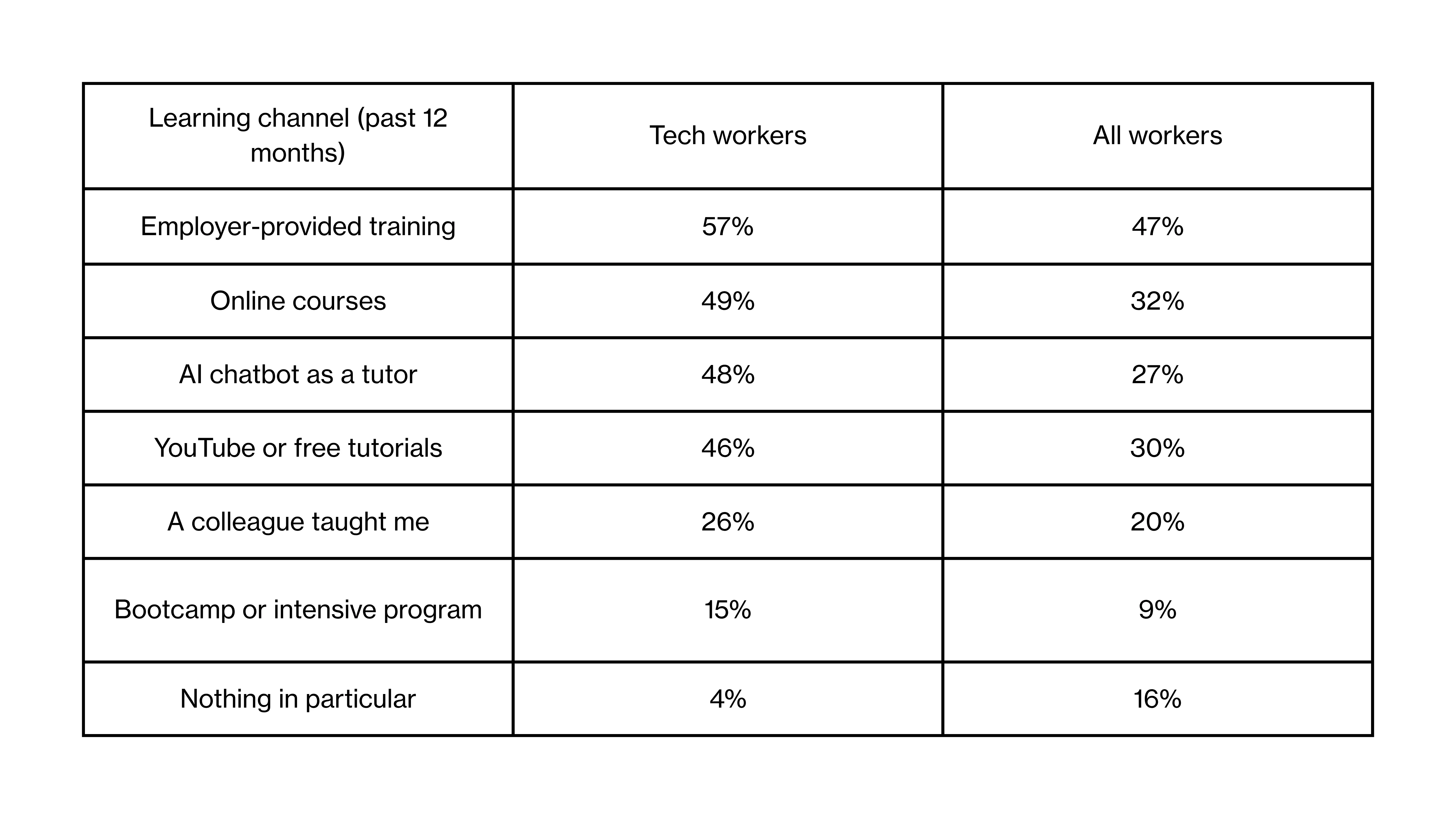
Tech workers also draw on AI chatbots for learning more often: 48% use them as learning tools, compared with 27% of all workers and 21% of workers outside tech. Still, when asked who they trust most to teach them a new job skill, workers most often chose someone already doing that job (31%). Certification programs drew 19%, AI tools 16% and university professors 6%.
Figure 3: Professional development patterns track the AI adoption curve.
Source: TripleTen, 2026
For leaders beyond tech, the useful signal is how adoption connects to specific tasks and skills, not which sector appears ahead. Workers can build experience by testing appropriate uses, learning to assess outputs and sharing processes that improve routine work. Those capabilities may become standard expectations as AI reaches more teams.
This content was produced by TripleTen. It was not written by MIT Technology Review’s editorial staff.