A security emergency with a sprawling footprint
The immediate challenge with PHP’s latest security emergency is its reach: the two flaws affect every web server running PHP 5.4 or later, and attackers have already begun exploiting them. PHP has released fixes, but updating the software behind millions of sites will take time. A patch can be published in hours; getting it into every hosting environment, application stack and independently managed server is a much slower process.

Image: Shutterstock.com, Sashkin.
The vulnerabilities, tracked as CVE-2026-109618 and CVE-2026-109619, can let an attacker run code on a vulnerable server. Depending on the attack, the impact may include remote control, denial of service or exposure of data. Those outcomes describe a range of possible damage, rather than a single guaranteed result: exposure depends on how a system is configured and what an attacker can reach.
Patch availability meets deployment scale
PHP issued an emergency update covering versions 8.5.12, 8.4.27, 8.3.36 and 8.2.35. The affected software underpins major publishing and commerce platforms, including WordPress, Drupal, Magento and Joomla, so remediation depends on a wide mix of hosting providers and organizations that manage their own infrastructure. In practice, that means the fix has to travel through multiple layers: PHP packages, server images, hosting control panels and the applications that depend on them.
Censys estimates the footprint at roughly 2.58 million internet-facing hosts and 54.9 million web properties running PHP. Those figures help explain why patching may stretch well beyond the initial disclosure: a web property isn't necessarily a separate server, and a single provider may manage many installations. Wiz researchers say every PHP version released over the past decade contains at least one of the flaws. That broad version history leaves operators with a significant inventory task before they can even confirm which systems need attention.
Cloudflare reported detecting exploitation and said it deployed web application firewall rules at 3:02 a.m. UTC to block traffic targeting the bugs. That kind of perimeter measure can buy operators time, but it doesn't replace updating the affected software. Reuters reported that government websites in Europe and elsewhere went offline on the day the vulnerabilities were disclosed. The report establishes an outage, though it doesn't by itself show that every affected site was compromised or explain the role these flaws played in each case.
Old flaws, newly practical exploits
Wiz researchers say the underlying issues had existed for decades, but turning them into a working exploit demanded a complex chain of steps. Their account credits frontier AI models with lowering the effort required to build an exploit from those long-standing flaws. The distinction matters: a bug can sit in software for years without being easy to weaponize, and a change in the effort required to exploit it can alter the practical risk for defenders.
OpenAI, which contributed to the vulnerability research and outreach, described the issues as unusually consequential because PHP remains so widely used. Wiz warned that attackers may use successful intrusions to install web shells: browser-accessible tools that let them control compromised sites remotely. A web shell can give an intruder a foothold for further activity, which is why operators need to consider both patching and checking for signs of access that may have happened before the fix was applied.
Before public disclosure, Wiz worked with the PHP team, Calif and OpenAI to assess the exposure and coordinate patch verification. The researchers compare the remediation challenge with Log4Shell, the 2021 vulnerability in the widely deployed Log4j Java logging framework. The comparison is about the difficulty of reaching a broad, diverse base of users, not proof that the two incidents will unfold in the same way. Their central point is practical: a defect in core PHP can affect cloud services, hosting companies, content delivery networks and independently run servers at once. The coordination work is only the first step; each operator still has to identify and update the systems they control.
Updates are already spreading through the ecosystem
The SANS Internet Storm Center is tracking software vendors as they publish fixes. Ubuntu, for example, has released updated PHP packages. Calif has also published a comic-book-style account of the discovery timeline and technical details. Vendor-specific packages matter because many administrators receive PHP updates through their operating system or hosting provider rather than directly from the PHP project.
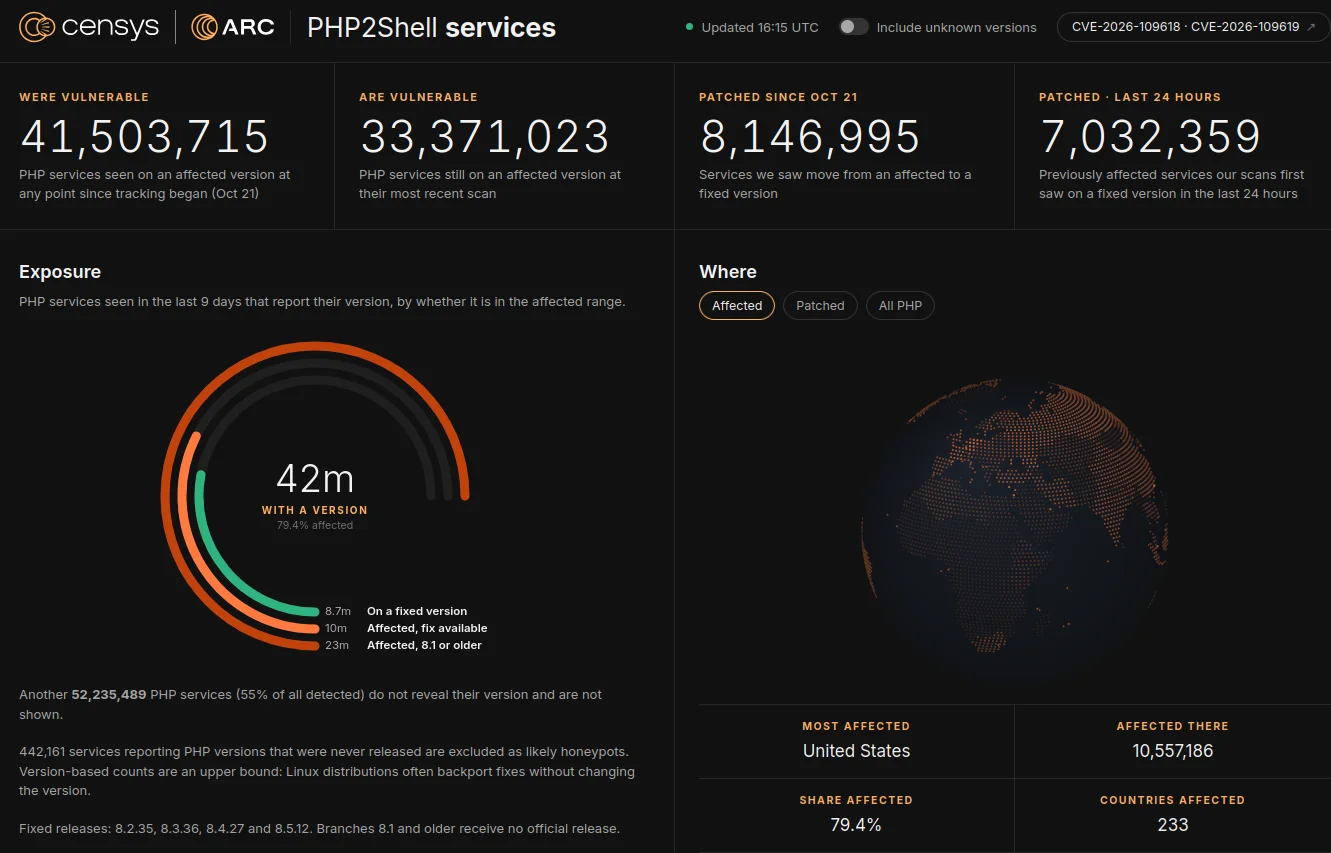
A snapshot of php2shell.censys.com, the website Censys set up to track the PHP vulnerabilities.
The longer test is operational
Here's the thing: publishing a patch sets a response in motion; it doesn't show that the vulnerable systems have been found, updated or checked for compromise. The coming test is whether operators can identify their PHP versions and apply the right package before attackers turn early exploitation into broader compromise. If you're working in this space, the task starts with inventory: know which systems run PHP, how they receive updates and who is responsible for applying them.
This is more significant than it looks because core infrastructure can sit beneath many unrelated sites and services. With PHP spread across independently managed systems, closing the gap will require sustained patching well after the emergency release (and this is the part most people overlook). The early reports of exploitation make delay more consequential, while the scale of the installed base makes instant, universal remediation unrealistic. A long tail of unpatched systems is the risk to watch.
This is a fast-moving story. Updates will be noted here with timestamps.
Update, 2:30 pm ET: Added Censys figures and a link to Calif’s writeup.


