FADU’s File-Semantic SSD (FS-SSD) shifts file handling into the drive, aiming to let GPUs, DPUs and network cards access files without routing requests through a host filesystem and storage CPU. The approach could reduce processor overhead in data-intensive systems, though the performance figures published so far are preliminary and the company’s prototype results still need validation on production hardware.
FADU, a Seoul-based fabless SSD controller designer, announced FS-SSD at the 2026 OCP Global Summit. Its white paper describes file operations carried through standard NVMe commands, with the drive handling path lookup, access checks and the mapping between files and flash. FADU told Tom’s Hardware Premium it expects partner samples in Q3 2027.
File access without the host storage stack
The technical case starts with a bottleneck in accelerated storage systems. GPUs have handled more of the data path for years, but the operating system’s filesystem and block layers can still consume CPU time while preparing and managing I/O. FADU estimates those layers account for about 30% of CPU cycles in a GPUDirect Storage random-read workload.
Existing bypass methods can reduce host involvement, but often give up ordinary file-level access. FS-SSD’s pitch is to keep that interface while moving the work into the SSD. A GPU can place NFS-over-NVMe commands in queues held in its own memory, including high-bandwidth memory. A SmartNIC or DPU can also submit commands to the drive, then receive data through PCIe peer-to-peer DMA and send it over RDMA.
FADU names GPU file reads and checkpoints, DPU-based HTTP content delivery, and just-a-bunch-of-flash (JBoF) file servers as target workloads. The design supports PCIe today, while NVMe-oF over RDMA or TCP can carry the commands without requiring a new transport.
A compact file layer designed around flash
FS-SSD uses NFSv3, which FADU describes as a small, stateless protocol with 21 operations and low firmware overhead. Underneath, the file layer derives from F2FS and combines filesystem functions with the SSD’s flash translation layer. File and data structures align with flash pages, while sections align with erase units. The resulting F2FS node table acts as a “File Map,” connecting node IDs to physical flash locations.
That layout also changes how the drive uses DRAM. FADU says FS-SSD needs roughly the same DRAM capacity as a conventional SSD: around 0.1% of NAND capacity, or about 1 GB per terabyte. A conventional drive uses most of that memory for its mapping table. In FADU’s design, about 95% can instead serve as a cache for frequently accessed file nodes.
The design also combines filesystem cleanup and SSD garbage collection into one process. FADU says this avoids the “double GC” effect, in which host-side F2FS cleanup and the drive’s own garbage collection can amplify each other’s work. Its research prototype showed 63% lower write amplification than host F2FS on a workload mixing sequential and random writes. That result came from synthetic fio tests running on NVMeVirt, an open-source SSD emulator from Seoul National University, so it does not yet represent a hardware measurement.
Early results show a strong server-side contrast
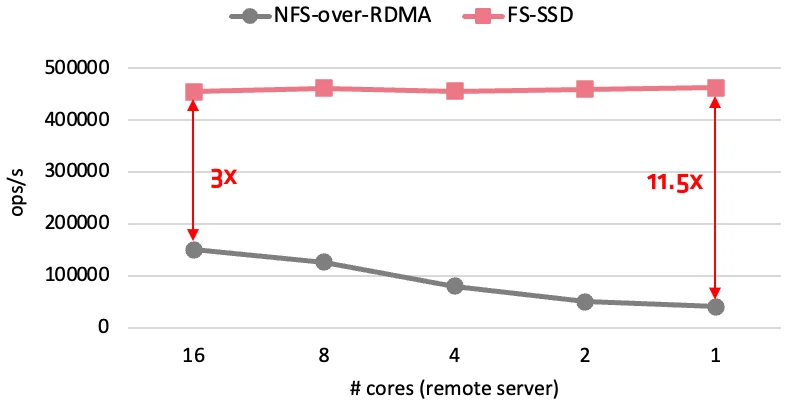
FADU’s preliminary NFS-over-NVMe Filebench test reported about 460,000 operations per second as the server allocation dropped from 16 cores to one. In the company’s comparison, Linux NFS over RDMA delivered about 150,000 operations per second with 16 cores and 40,000 with one. The result suggests FS-SSD could keep file-serving throughput steadier as host CPU resources shrink.
The test used an Intel Core i5-13600K on both client and server, 128 GB of DDR5 memory, and a Mellanox ConnectX-6 100 Gbps network card. FADU compared fio results for F2FS and Ext4 on block firmware with FS-SSD using both a kernel client and an SPDK user-space client. Sequential tests used one thread, a queue depth of 128 and 128 KB blocks. Random tests used four threads, the same queue depth and 4 KB blocks.
Setup | Sequential read (MB/s) | Sequential write (MB/s) | 4KB random read (MB/s) | 4KB random write (MB/s) |
|---|---|---|---|---|
F2FS | 14,120 | 4,510 | 7,850 | 3,980 |
Ext4 | 14,130 | 7,050 | 9,120 | 4,560 |
FS-SSD (kernel client) | 14,140 | 11,940 | 8,070 | 4,320 |
FS-SSD (SPDK client) | Not reported | Not reported | 13,000 | 7,030 |
Raw block (SPDK) | Not reported | Not reported | 13,990 | 13,240 |
Against raw-block SPDK results, FS-SSD’s SPDK client retained about 93% of 4 KB random-read throughput and 53% of random-write throughput. That puts the file layer’s reported cost at roughly 7% for reads and 47% for writes. The kernel client’s random-read figure was 11.5% below Ext4, while its random-write result trailed by 5.3%.
These results need context. Although the drive uses FADU’s Gen6 controller, testing took place in a PCIe 5.0 host, which capped sequential reads at roughly 14.1 GB/s. The 13,240 MB/s raw-block random-write result also exceeds the approximately 12 GB/s NAND program bandwidth FADU cites, suggesting the run may not have reached steady state.
The Filebench workload is particularly favorable to a file-aware drive: it uses 10,000 files in a multilevel directory tree, a mean directory width of 20, average file sizes of 128 KB and 50 client threads. That makes it metadata-heavy, with substantial work in the host filesystem. The one-core server comparison is a useful demonstration, but it remains a vendor-run result on a consumer-class desktop platform.
Coordination and security need clear answers
Moving filesystem work into the drive raises practical questions about simultaneous writers, cache coherence and access control. FADU says FS-SSD does not implement NFS’s lock manager, so there is no cross-host locking. Each write is applied whole and in order; when two writes target the same location, the later one takes precedence. Kernel clients use their usual advisory locks among themselves, while GPU and SPDK clients must coordinate through their applications. At larger scale, a pNFS metadata server handles coordination.
Cache handling follows the same split: kernel clients use ordinary NFS caching, while GPU and SPDK clients either manage caching themselves or avoid it. This matches standard NFSv3 behavior, but it leaves system designers responsible for coordinating clients that share data.
Access checks also move into the SSD. User and group IDs arrive with each command, which could let an untrusted client claim another identity. FADU says it addresses that risk with capability-based authentication: an external authentication server issues a capability, and the command carries a code calculated with a key shared by that server and the drive. The published material doesn’t detail the mechanism; FADU says Kerberos support is planned. Networked drives use standard NVMe-oF protections and admit only pre-approved hosts.
The current release lacks ACLs and several other filesystem features, according to FADU. Drive encryption is available through the FC6161 controller’s standard TCG Opal self-encrypting drive support. For power loss, FADU describes using capacitors to flush metadata, buffered writes and a log of operations in progress. After restart, the drive replays unfinished operations; an acknowledged write is meant to be durable.
Roadmap points toward hostless flash shelves
FADU’s longer-term target is a JBoF system built from FS-SSDs, a PCIe switch and a DPU or NIC that handles NVMe-oF in hardware. The company estimates that this design could use about 42% less power and cut cost per 16-drive server by about 57%, while increasing rack density and lowering five-year total cost of ownership. Those are FADU projections, not independently verified results.
Milestone | Timing (per FADU) | Details |
|---|---|---|
Gen6-host results | By Q1 2027 | FS-SSD tested in a PCIe 6.0 host; hardware write-amplification figures to come with them |
Partner samples | Q3 2027 | OEM/ODM talks are at an early stage; active collaboration expected once samples ship |
Hostless JBoF | By end of 2027 | Reference design built on Xsight Labs E1 DPUs, delivered to OEM/ODM partners |
GPU access | Now, via GPUDirect Storage | Works with GDS through the kernel client; FADU intends to join the Accelerated IO SIG (xio-sig), where Nvidia open-sourced cuFile; no direct engagement with Nvidia |
Standards | Nothing submitted yet | FADU plans to start a file-semantic command set discussion at NVM Express and OCP Storage; samples and client code come first |
FADU says it plans to deliver PCIe 6.0 host results by Q1 2027, with partner samples expected in Q3 and a hostless JBoF reference design by the end of that year. The company has not yet submitted a standards proposal, though it plans discussions at NVM Express and OCP Storage after samples and client software are available. Its controllers already ship in drives such as the SN861, launched by Western Digital and now sold by SanDisk.
FS-SSD’s central idea is to preserve file semantics while taking filesystem work off the host processor. The current numbers make that case most clearly in metadata-heavy serving and low-core scenarios. Gen6-host measurements, hardware write-amplification data and working samples will show whether the design can deliver those gains across production systems, where client coordination and filesystem feature support matter as much as raw throughput.