DeepSeek V4.1 Flash 1017 makes a strong case for running capable AI agents at lower cost. Its efficiency gains and coding benchmarks stand out, but the model’s tendency to invent answers when uncertain limits where teams should use it.
Efficiency is the clearest upgrade
The 1017 revision of DeepSeek V4.1 Flash, or DSF, is a 552-billion-parameter mixture-of-experts model that activates 16 billion parameters per run. It accepts text and image inputs and supports a context window of 1 million tokens. DeepSeek describes it as suited to “wish-driven programming made real,” a pitch aimed at broad, open-ended coding instructions.
The revision’s practical advance is how much less memory it needs for its KV cache. Compared with V4 Flash, V4.1 Flash uses one-quarter the HBM and one-eighth the SSD storage, at 890 bytes per token entry. That reduction matters for long-running agent tasks, where context and repeated inference can drive up infrastructure costs.
DeepSeek’s pricing puts the efficiency into concrete terms: during off-peak periods, a million input tokens cost $0.15 and a million output tokens cost $0.60. Cached input falls to $0.003 per million tokens. The model is open-weight and can run on other providers, some of which have previously priced below DeepSeek’s API rates. DeepSeek’s search API costs $0.75 per 1,000 queries; the article identifies Parallel, at $1, as the nearest comparison.
Strong results, especially on coding tasks
On DeepSeek’s cost-per-task chart, built from the September 2 DeepSWE dataset, both V4.1 Flash variants land in the high-performance, low-cost area. The 1017 version’s low-effort runs reach completion rates around those of more expensive competitors at maximum settings. DeepSWE is one benchmark, so it offers a useful signal rather than a complete verdict.
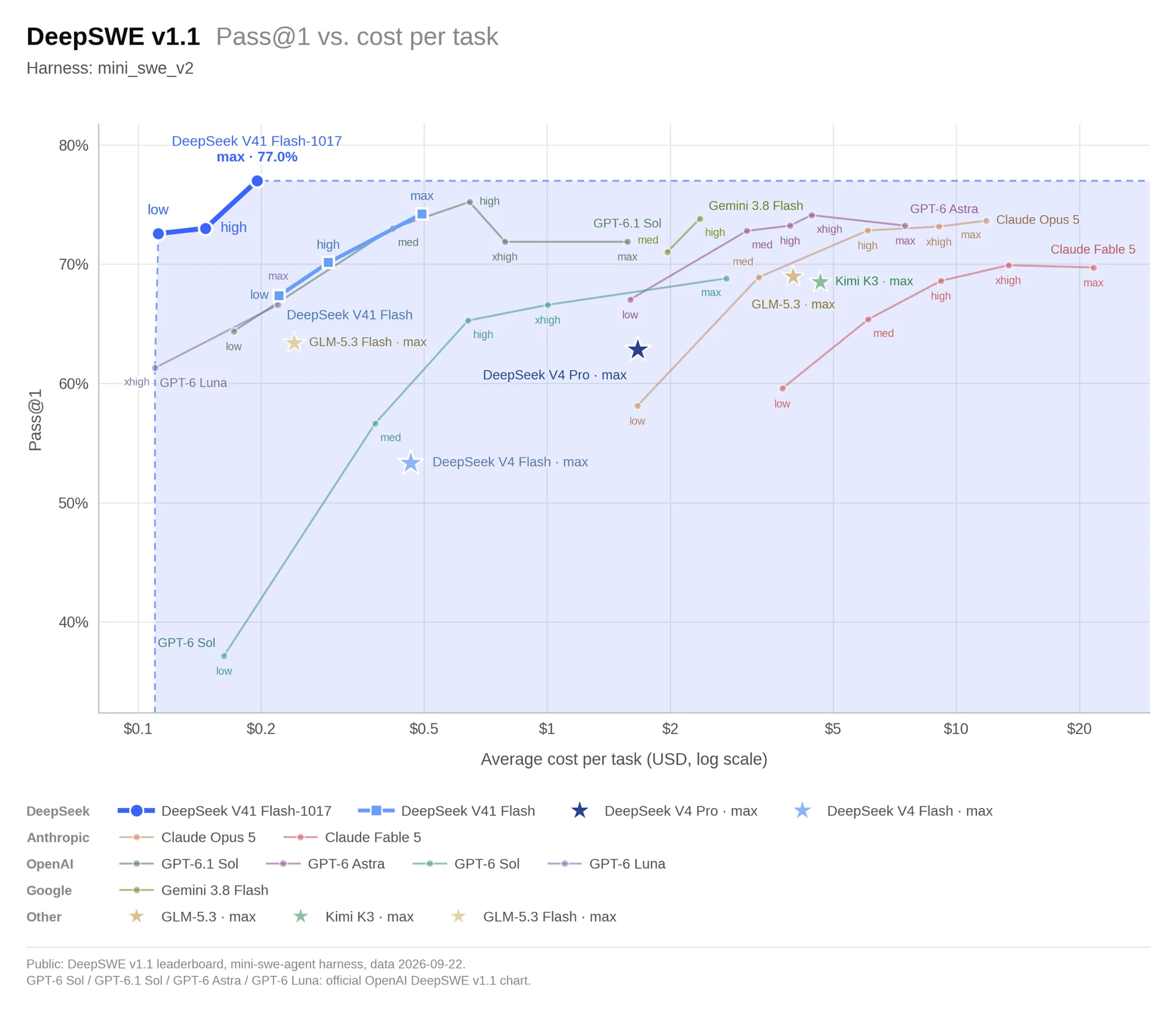
Artificial Analysis ranks DSF-1017 at No. 2 in its large open-weight class, with an intelligence score of 45. Claude Opus 5.5, using max settings with fallback, scores 58. The DeepSeek model is also among the fastest in its category, while Xiaomi’s MiMo V2.6-Pro has a lower cost per task.
Those results put DSF-1017 in a useful middle ground: it can handle substantial work for less than leading proprietary models, though it doesn’t match them on every measure. For software teams, the key question is whether a task’s output can be checked independently.
Hallucinations narrow the use cases
Artificial Analysis’ Omniscience benchmark reveals the tradeoff. DSF-1017 answers correctly 43% of the time, a strong result among open-weight models, but it hallucinates 67% of the time when it should decline to answer. The benchmark rewards correct responses and penalizes wrong ones, while abstentions don’t count. DSF-1017 scores 5 points, compared with 20 for Kimi K3-max and 42 or more for frontier models.
That pattern suggests the model has trouble recognizing when its information is insufficient. Raw capability doesn’t solve that problem: a system can perform well on tasks and still confidently supply unsupported details. The result is a model that needs workflows built around verification.
Programming tasks with runnable tests, OCR followed by review, and format conversions are better fits. In those cases, an agent can check its work and retry when validation fails. Open-ended research, factual lookups, and precise document drafting carry more risk because unsupported claims can be difficult to catch automatically.
Cheap intelligence still needs oversight
DeepSeek’s tradeoff echoes reports of strong but unreliable open-weight models such as Kimi K3. The appeal is clear: lower inference costs can make AI agents practical at higher volumes and give developers more choices as frontier model prices change. But cheaper tokens don’t remove the cost of checking an answer.
For teams considering DSF-1017, the most practical approach is to match it with tasks that have clear success criteria and automated checks. Its efficiency can expand what’s affordable to run; its hallucination rate means factual judgment still needs a dependable backstop.


